Sports Fan Engagement Platform for Interactive Campaigns
By Arpan Desai, Founder, SportsFirst
A no-code sports fan engagement platform for clubs, leagues, federations, collegiate programmes and sponsors to create polls, predictions, quizzes, competitions and branded campaigns, capture consented fan data, and measure sponsor performance without rebuilding each experience from scratch — supported by a functional concept prototype.
- Theme
- Fan engagement & personalisation
- Relevant to
- Professional club, League office, Federation / governing body, Collegiate athletics, Venue & stadium operator
A proposal from SportsFirst. This is a proposed production platform supported by a functional concept prototype — not a description of a fully launched commercial product. Any performance figures shown inside the prototype are illustrative, not SportsFirst customer results. A live pilot would establish actual adoption, engagement and commercial outcomes.
Launch fan campaigns without waiting for development. A reusable engagement layer that marketing, fan engagement and commercial teams operate themselves.
Explore the functional prototype Demo accounts are on the sign-in screen. Everything below describes what a production build would need on top of it.
1. The Opportunity
Sports organisations run a constant stream of digital fan engagement campaigns.
Vote for player of the match. Predict the score. Enter a competition. Complete a supporter survey. Test your knowledge. Choose the next kit. Upload a matchday photograph. Claim a sponsor reward.
Each interaction looks simple to the fan. Launching it usually involves several disconnected teams and systems: marketing develops the idea, a designer prepares creative, a developer or agency builds a landing page, legal reviews the consent wording, data is exported into a spreadsheet, and sponsor reporting is assembled by hand after the campaign closes.
Campaign opportunities appear around fixture announcements, player signings, matchdays, halftime, drafts, tournaments, kit launches, awards, sponsor promotions and community events. A campaign that takes three weeks to design and build can miss the moment entirely.
Even an organisation that already has a CRM, a mobile app, an email platform and a sports marketing platform may still lack one practical system for creating, approving, publishing and measuring interactive campaigns. Four problems recur:
- Campaigns take too long to launch.
- Successful mechanics are rebuilt instead of reused.
- Valuable fan responses stay in disconnected exports.
- Sponsors receive surface-level reach figures rather than evidence of interaction.
The opportunity is not another poll tool. It is a reusable sports fan engagement platform the organisation operates itself.
2. What We Propose to Build, With You
A multi-tenant, no-code sports fan engagement platform for interactive campaigns.
A campaign manager selects a sports-ready template, configures the interaction and the campaign rules, applies club and sponsor branding, defines what fan data to capture, previews across devices and publishes through a hosted URL, QR code, website embed or in-app web view.
Fans get a lightweight, mobile-first experience with nothing to install. Depending on the campaign they vote, predict, answer questions, enter a competition, upload content, select a player, claim a reward, submit preferences or join a sponsor activation.
The organisation sees participation, completion, response distribution, consent, CTA activity, audience growth and sponsor performance through one reporting layer.
Four outcomes shape the design:
- Faster campaign delivery. Marketing and commercial teams launch repeatable campaigns without waiting for a bespoke development cycle. The workflow moves from idea, brief, design, development, QA, legal, publish to template, configure, approve, publish.
- Better digital fan engagement. Branded, mobile-first experiences that feel native to sport rather than a generic web form.
- First-party fan data and declared preferences. Useful supporter behaviour and preferences captured with clear consent — favourite player, favourite team, attendance intent, merchandise interest, content preference, sponsor-category interest, competition participation, reward activity. The goal is the minimum useful information in exchange for a clear fan benefit, not the maximum collectable.
- Measurable sponsorship activation. Show partners what fans did, not only how many impressions a logo received.
3. Why This Problem, Why Now
Fan engagement campaigns are event-driven
The window opens and closes with the fixture. A three-week development process misses it. A reusable campaign engine lets a team respond to matchday, commercial and content moments at the speed those moments actually move.
First-party relationships are increasingly valuable
Social platforms generate reach and return limited direct insight about the individual supporter. An owned interactive campaign can capture declared interests and preferences with consent, in context, attached to a record the organisation keeps.
Sponsors need measurable interaction
Participation, CTA clicks, reward claims, opt-ins, declared preferences and repeat engagement make a stronger activation story than placement alone — provided the data is collected consistently and reported transparently.
Existing tools are rarely sports-native
Generic forms capture responses. CRMs store contacts. Marketing automation sends messages. The missing layer is the sports interaction itself: match predictions, player voting, sports trivia, Pick'em games, sponsor rewards, fixture-linked competitions, matchday surveys and fan challenges.
4. The Foundation
A functional concept prototype already exists to demonstrate the product direction. It represents the multi-organisation platform structure, organisation and campaign roles, campaign dashboard, guided campaign builder, reusable templates, campaign lifecycle states, fan-data capture, consent management concepts, brand and sponsor customisation, responsive preview, hosted publishing, QR-code publishing, embed options, campaign-performance reporting, audience-management concepts, integration settings and account administration.
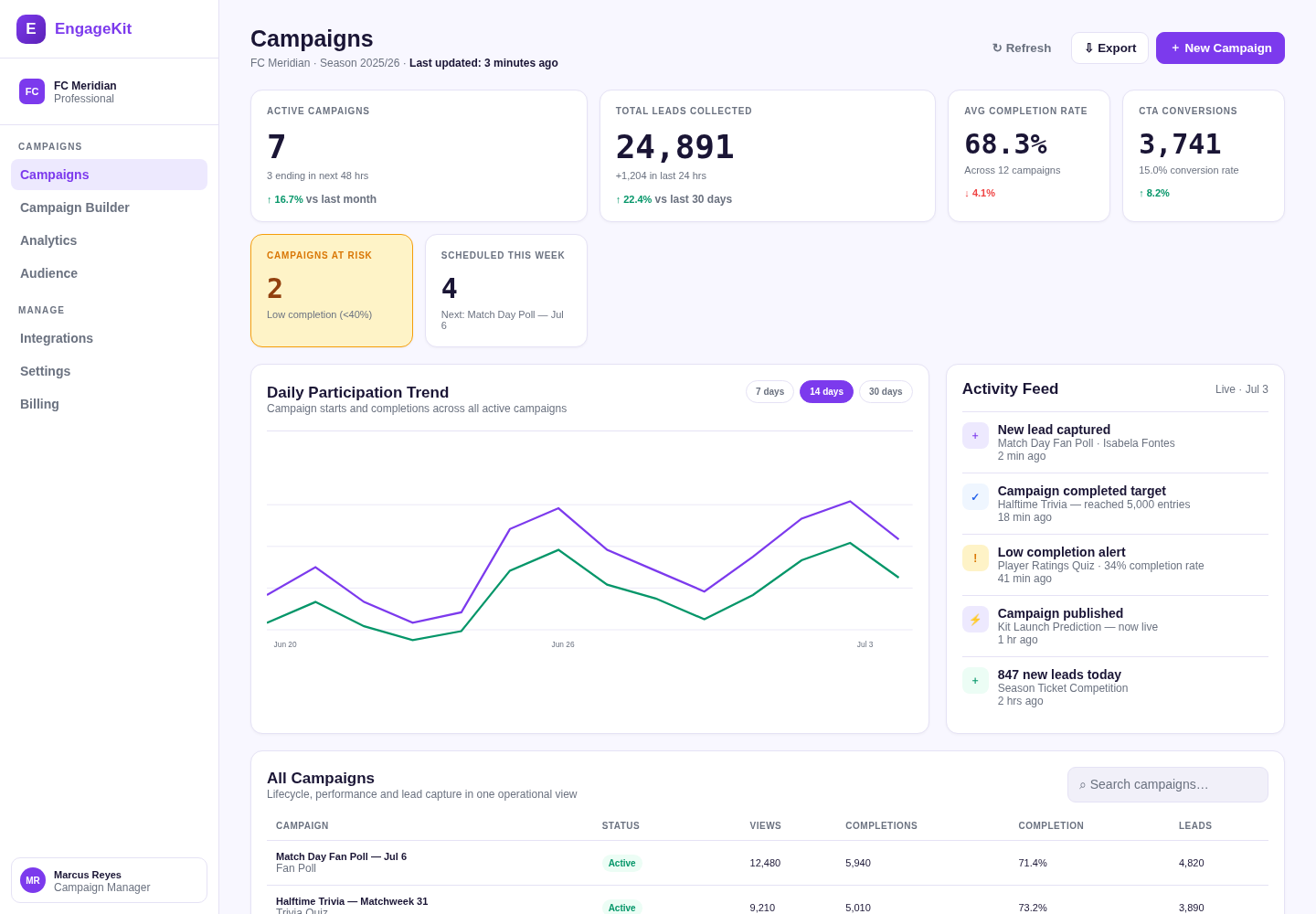
Functional concept — campaign operations dashboard. The screen models campaign lifecycle states, completion and drop-off visibility, first-party lead capture, CTA measurement, campaign risk and scheduled activations. Every figure shown is illustrative demo data.
A production platform would still require validated requirements, production architecture, real authentication, secure tenant separation, campaign versioning, operational controls, tested campaign logic, analytics instrumentation, consent workflows, fraud and abuse prevention, live integrations and security testing.
Please note: engagement figures inside the demonstration interface are illustrative of the conceptual flow. In published material the prototype should be described as a functional concept prototype with a pilot partner wanted, never as company traction.
What the prototype settles, and what it deliberately leaves open:
| Prototype evidence | What it demonstrates | What a pilot still decides |
|---|---|---|
| Campaign manager, organisation admin and analyst roles | Distinct operating roles have been thought through | Which roles your organisation actually needs, and who approves a campaign |
| Campaign operations dashboard | Day-to-day management is part of the product, not an afterthought | Which states and signals matter to your team |
| Guided no-code builder | The build workflow has a concrete information architecture | How much configuration a marketer should see before it becomes a burden |
| Sports-ready template library | The concept is sports-native rather than a generic form tool | Which mechanics ship first |
| Lead and consent configuration | First-party capture is deliberately configurable, not fixed | Your consent model, retention periods and controller responsibilities |
| Hosted URL, embeds and QR | Distribution was designed across digital and physical channels | Which channels you publish through |
| Analytics and webhook settings | It is intended to connect to an existing data stack | Which CRM, ticketing, identity and sports-data integrations matter |
The value of a functional concept is that a pilot starts by simplifying a working model rather than from a blank page. Stakeholders can react to real workflows, remove what does not fit their organisation and prioritise what does.
Campaign engines, not campaign types
The first production release should ship a small number of flexible engines rather than a separate codebase per campaign format.
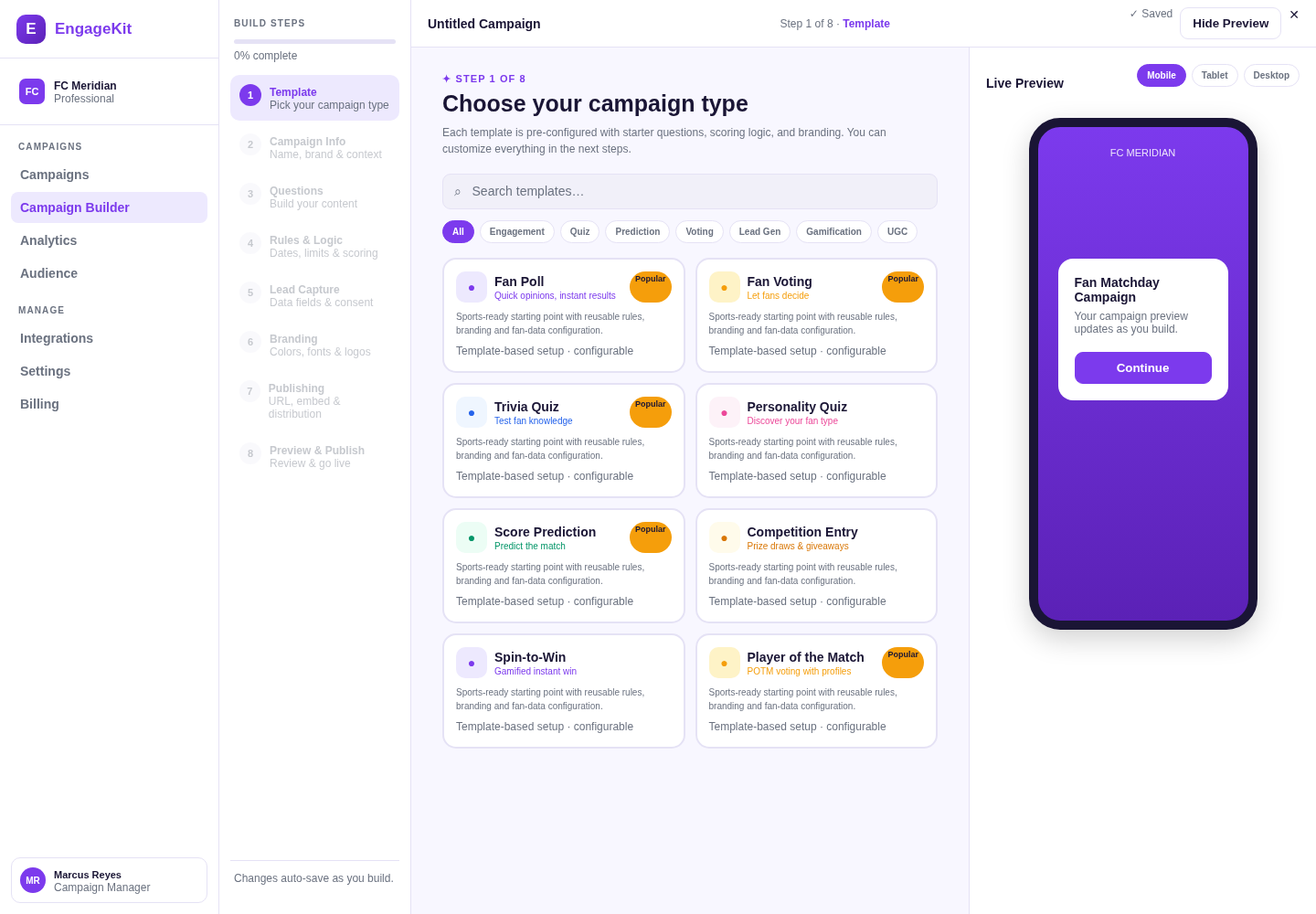
Functional concept — the sports-ready template library, covering voting, quizzes, predictions, competitions, user-generated content, gamification and sponsor lead capture. The distinction this makes visible is between a generic form builder and a sports-native campaign system.
The templates are the surface a campaign manager sees. Underneath, they should resolve to a handful of reusable engines — voting, quiz, prediction, competition and form — so that adding a campaign format stays configuration rather than a new codebase to maintain through every season.
- Voting engine. Fan polls, player-of-the-match voting, kit voting, fan choice, awards voting.
- Quiz engine. Sports trivia, knowledge quizzes, scored quizzes, outcome quizzes.
- Prediction engine. Match-score predictions, first-scorer predictions, Pick'em campaigns, tournament selections, season predictions.
- Competition and form engine. Prize draws, sponsor lead generation, supporter surveys, competition entry, fan feedback.
Follow-on engines could add photo and video submissions, instant-win mechanics, spin-to-win, leaderboards, referral campaigns and digital challenges. The discovery question is always whether a proposed campaign is a new engine or a configuration of an existing one — building twelve templates when the pilot needs four engines is the standard failure here.
How a campaign gets built
Select a format. Start from a template, a previous campaign or a blank one. Duplication is a first-class feature: a player-of-the-match campaign is duplicated, updated for the next fixture and republished rather than rebuilt.
Enter campaign information. Name, internal reference, organisation, workspace, sponsor, season, competition, fixture, objective, target audience, start and close times, owner, collaborators.
Configure the interaction. Questions, answer options, images, players, teams, scores, prizes, CTAs and upload requirements, from a field set covering single and multiple choice, text, email, phone, number, date, dropdown, image selection, rating scale, consent checkbox and file upload.
Define the rules. Correct answers, scoring, outcome mapping, branching, entry limits, eligibility, opening and closing rules, randomisation, winner selection, prize inventory, result messages, CTA destination and repeat-entry rules.
Configure fan data capture. The organisation decides what is genuinely needed — name, email, mobile, age confirmation, postcode, region, favourite team, favourite player, attendance intent, merchandise preference, club marketing permission, sponsor marketing permission, terms acceptance. Consent stays separate from participation wherever required.
Apply branding. Club, league and sponsor logos, primary and secondary colours, background imagery, button styling, typography, headers, footers, CTA copy, completion screens and social-sharing imagery.
Preview, review and approve. Mobile, tablet and desktop preview, with a pre-publication checklist flagging missing content, missing privacy policy or terms, unset campaign dates, missing prize detail, a broken CTA, a missing sponsor logo, consent wording awaiting approval, test data still present and unconfigured integrity settings.
Publish and distribute. A hosted URL, QR code, website embed, in-app web view, email, SMS, social, stadium screen, broadcast graphic or sponsor-owned media. Campaign states: draft, scheduled, active, paused, completed, archived.
The campaign calendar
Because the work is event-driven, the platform needs a calendar view rather than a list. A matchday Saturday reads as the score prediction opening late morning and closing at kickoff, then player-of-the-match voting opening in the closing stages and shutting shortly after the whistle; Monday carries the post-match supporter survey; Wednesday the sponsor trivia campaign. One view of campaign activity against fixtures, events and sponsor obligations.
Campaign integrity
Prizes, voting and leaderboards attract manipulation. A production platform needs one entry per verified email or per authenticated fan, IP rate limits, device-level controls, bot detection, CAPTCHA where appropriate, duplicate-entry detection, disposable-address controls, suspicious voting-pattern detection, manual disqualification, audit logs and campaign-specific eligibility rules. Nothing should treat a submitted entry as valid simply because it arrived.
Fan data and segmentation
The platform does not replace the CRM. It captures the context a CRM record usually lacks: which campaign the supporter entered, what they selected, what they predicted, which topic interested them and what communication they agreed to receive. A participant profile can hold contact identifier, campaign history, submitted answers, declared preferences, favourite athlete and team, content and merchandise interests, reward history, communication permissions with their source and timestamp, withdrawal status, acquisition channel and campaign attribution.
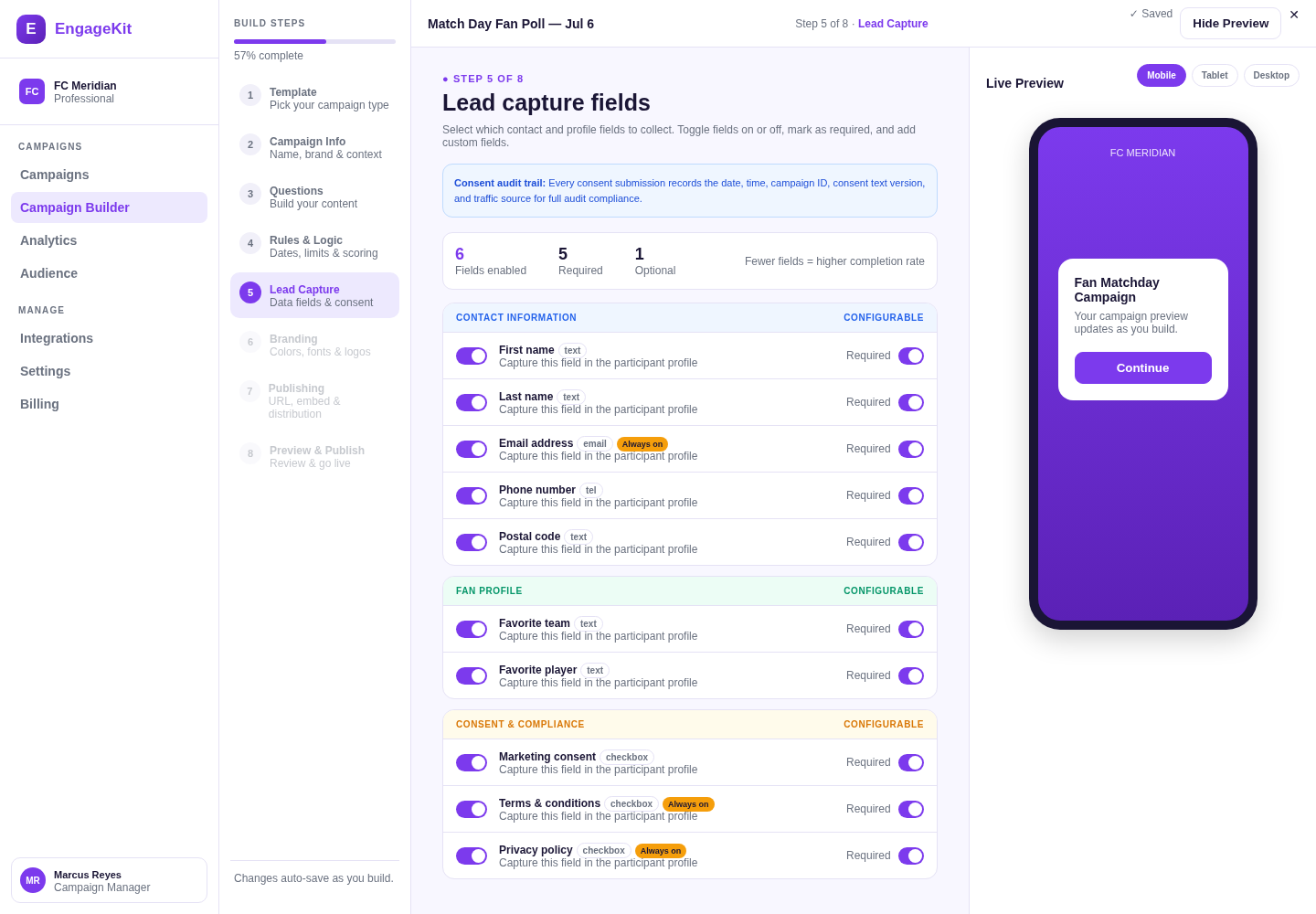
Functional concept — configurable fan-data and consent capture. The prototype separates contact information, fan-profile enrichment and consent and compliance fields, so a campaign manager decides what is genuinely worth collecting rather than accepting a fixed form.
Consent is treated as a product capability rather than a checkbox. The concept models an audit record for each submission holding campaign context, timestamp, the version of the consent text shown and the traffic source — which is what makes a permission defensible months later, when someone asks what exactly a supporter agreed to and on which screen. The specific consent model, retention periods, deletion process, controller and processor responsibilities and any jurisdiction-specific requirements would be settled with the pilot organisation and its legal team.
That supports segments such as match attendees who entered a prediction, supporters interested in women's-team content, fans who selected a particular player, competition participants who consented to club communication, sponsor campaign participants with separate sponsor permission, and supporters who repeatedly start campaigns without completing them. Advanced lifecycle marketing stays outside the first release unless the pilot needs it.
Sponsor activation and analytics
A predict-the-score campaign presented by a sponsor can report views, unique participants, starts, completions, sponsor CTA impressions and clicks, reward claims, sponsor-permission opt-ins, returning participants and engagement by acquisition channel. Sponsor-facing reporting stays permission-aware throughout.
Core campaign metrics: page views, unique visitors, starts, completed entries, completion rate, average completion time, question-level drop-off, response distribution, leads captured, consent rate, CTA clicks and conversion, reward claims, upload volume, source and UTM attribution, device type, campaign status and data-export activity. Sport-specific metrics: vote distribution, most-selected player, prediction distribution, correct-prediction rate, quiz score distribution, outcome distribution, prize allocation, valid and disqualified entries, leaderboard position.
5. Proposed Architecture
| Component | Responsibility | Main inputs | Main outputs |
|---|---|---|---|
| Organisation and tenancy layer | Separates organisations, brands, users and campaign data | Organisation structure, invitations, roles | Secure workspaces and permission boundaries |
| Template library | Reusable sports campaign starting points | Template definitions, configurable components | New campaign configuration |
| Guided campaign builder | Content, rules, fan data, branding and publishing in one flow | Campaign-manager configuration | Validated campaign version |
| Campaign runtime | Delivers the supporter-facing experience | Published configuration, participant actions | Responses, submissions, completion events |
| Rules and outcome engine | Scoring, eligibility, branching, winner and result logic | Answers, configured rules, campaign state | Score, outcome, eligibility or winner status |
| Campaign integrity engine | Rate limits, duplicate detection, anti-bot controls, audit rules | Entry attempts, device and network signals | Valid, flagged or blocked entries with a reason |
| Audience and consent layer | Fan identity, permissions and declared preferences | Form fields, consent choices, campaign history | Consent record and audience profile |
| Asset and brand system | Organisation and sponsor branding | Logos, imagery, styles, brand kits | Responsive branded campaign |
| Sports event state layer | Fixtures, rosters, event state and campaign timing | Manual controls or a data provider | Correct opening and closing behaviour |
| Analytics pipeline | Views, starts, responses, completions, CTA events | Campaign and attribution events | Dashboards, reports, exports |
| Sponsor reporting layer | Sponsor-specific activation reporting | Campaign events, permission scope | Permission-aware sponsor report |
| Publishing layer | Hosted URLs, embeds, QR codes | Approved campaign version | Distributable campaign |
| Campaign calendar | Organises campaigns around fixtures and commercial events | Fixture list, campaign schedule | One operational view |
| Integration layer | Connects campaign data to existing systems | Webhooks, APIs, exports, mappings | CRM, email, warehouse or ticketing updates |
| Platform administration | Tenants, security, usage, incidents, operational controls | Account and system activity | Auditability, support, oversight |
Final technical boundaries would be defined during discovery. The table is a capability model, not a fixed implementation.
Roles and governance
A production platform supports platform administrator, organisation owner, organisation administrator, campaign manager, content editor, analyst, agency user and sponsor or client reviewer roles. Material actions are auditable: publication, rule changes, consent changes, winner selection, data export, deletion and disqualification.
Sports gamification, where it earns its place
Predictions, Pick'em games, quiz scores, points, leaderboards, streaks, challenges, rewards, digital badges and season-long competitions drive repeat participation. Each should be added against a stated engagement objective rather than because the category expects it.
6. Scenarios We'd Target Together
Matchday score prediction
A club publishes a score prediction several hours before kickoff. The supporter selects a score, optionally picks a first scorer, submits and receives a sponsor-presented confirmation. Entries close automatically at kickoff. The club gains measurable pre-match engagement; the sponsor receives participation, completion and CTA figures.
Player-of-the-match voting
A league opens voting late in the fixture and closes it shortly after the whistle. Players load from the match roster, voting is limited by the agreed rules, and the result reaches an authorised content team first — the public result can wait until it has been reviewed rather than publishing before the official announcement.
Sponsor trivia activation
A partner sponsors a short fixture-linked quiz combining sport questions with relevant sponsor content, without forcing the brand into every screen. Fans who complete it may enter a draw or unlock an offer. Reporting separates campaign participation from marketing consent, so the sponsor receives only what it is permitted to receive.
The vote somebody tries to rig
An awards vote attracts coordinated entry from a single network range. Rate limits and duplicate detection flag the pattern, the entries are quarantined rather than silently counted, and an administrator disqualifies them with a logged reason. The published result survives scrutiny because the audit trail exists.
Kit or merchandise vote
Supporters choose between concepts, colours or product options. Results can be segmented by supporter type, geography, attendance history or declared preference where the integrations and permissions exist, producing both engagement and structured product insight.
Post-event supporter survey
An event organiser runs a branded mobile-first survey after attendance. Responses connect to the event or ticket category within the agreed consent boundaries, and the organiser sees completion, drop-off and response distribution instead of an unstructured spreadsheet.
7. Standards, Regulations & Governing Rules
Exact requirements depend on campaign type, participant age, sponsor category and launch jurisdiction.
| Area | Why it matters | Proposed platform response |
|---|---|---|
| Data protection | Campaigns collect personal information and behavioural data | Data minimisation, documented purpose, configurable retention, export, deletion and access controls |
| Marketing consent | Competition entry and marketing permission are not the same action | Separate consent fields, clear wording, consent timestamp and source |
| Children and younger supporters | Some campaigns attract or target minors | Age-aware flows, guardian requirements where applicable, reduced collection, restricted profiling |
| Competition and prize rules | Draws, instant wins and judged competitions carry different obligations | Configurable terms, eligibility, opening dates, winner method, audit record, prize inventory |
| Campaign integrity | A manipulated vote or draw is a reputational and legal problem, not a data-quality one | Entry controls, anomaly detection, quarantine, disqualification with reason, full audit history |
| Accessibility | Campaigns must be usable across a wide range of supporter needs | Keyboard support, semantic controls, readable contrast, text alternatives, accessible validation |
| Sponsor restrictions | Certain categories and competitions restrict commercial activation | Sponsor-category controls and an approval workflow rather than free-text instructions |
| User-generated content rights | Uploads create ownership, consent and moderation questions | Rights confirmation, moderation queue, reporting and removal workflow |
| Data sharing | Club, agency and sponsor have different rights to campaign data | Explicit controller and recipient configuration, restricted exports, auditable access |
| Security and tenancy | One organisation must never reach another's data | Tenant isolation, encryption, role-based access, audit logging, controlled support access |
The platform supports these workflows. Campaign owners remain responsible for approving terms, eligibility and jurisdiction-specific legal requirements.
8. How the System Would Integrate
- CRM. Create or update supporter records, attach campaign participation, preserve permission status. A first release can use controlled exports or one CRM integration rather than supporting every provider.
- Email and messaging. Move consented contacts into an agreed audience or journey, respecting unsubscribe and suppression status in both directions where synchronisation is enabled.
- Ticketing and membership. Use supporter identifiers, fixture information or membership status to personalise, validate or gate member-only campaigns. Start narrow and read-only unless a write workflow is clearly required.
- Sports data providers. Load fixtures, teams, players, rosters, event state or live results into prediction, voting and trivia campaigns, with manual or CSV-managed data as the fallback so a campaign never depends entirely on one feed.
- Data warehouse and BI. Send campaign events and audience data to the organisation's existing reporting environment.
- Websites and mobile applications. Publish through hosted links, responsive embeds or in-app web views.
- Identity and single sign-on. Staff authentication through the organisation's identity provider and, where appropriate, supporter sign-in through an existing account.
- Webhooks and APIs. Notify external systems when a campaign publishes, an entry arrives, a participant consents, a reward is claimed, an upload needs moderation or a winner is selected.
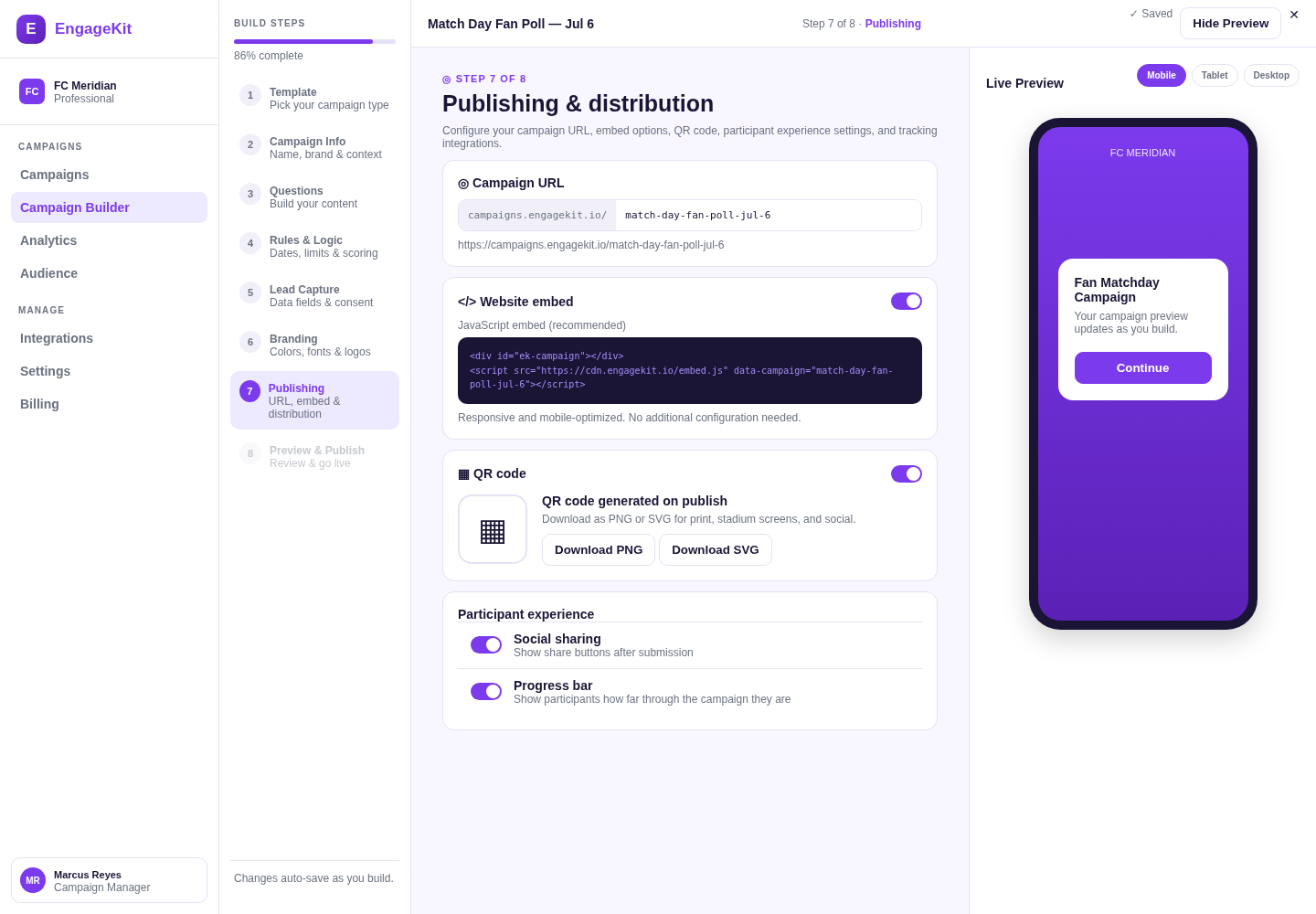
Functional concept — multi-channel publishing. One approved campaign configuration becomes a hosted URL, a website embed and a QR activation without rebuilding the experience per channel.
A campaign should be distributable wherever the supporter already is: the club or league website, an app web view, email, social, stadium signage, a hospitality environment, a broadcast graphic or sponsor-owned media. Building the campaign once and publishing it many ways is the part that decides whether a team runs one campaign a month or one a fixture.
9. Proposed Delivery Plan
Phase 1 — Campaign and operating-model discovery (Weeks 1-3)
Work with marketing, fan engagement, commercial, data and legal stakeholders to identify the initial campaign formats and the process around them. Outputs: pilot campaign inventory, shared component model, roles and approvals, fan-data schema, consent model, initial integrations, analytics definitions, sponsor reporting requirements, hosting and security requirements, and pilot success measures.
Phase 2 — Production platform foundation (Weeks 4-9)
Build authentication, tenant structure, roles, campaign dashboard, template framework, guided builder, brand management, campaign lifecycle, participant-facing runtime, event tracking, audience records, CSV export, audit logging, campaign duplication and the campaign calendar. Choose the first formats for maximum reuse: a poll, a quiz, a prediction and a competition form cover most of the shared foundation.
Phase 3 — Pilot campaigns and integration (Weeks 10-14)
Configure real campaigns with the pilot organisation. Add the required CRM integration, brand kits, approval workflow, QR and embed publishing, campaign integrity controls, privacy and terms configuration, sponsor reporting and operational support controls. Test internally before opening a limited campaign to supporters.
Phase 4 — Controlled live release (Weeks 15-18)
Launch a defined campaign set around real fixtures or commercial activations. Review setup time, participation, completion, drop-off, invalid entries, fan-data quality, consent clarity, sponsor reporting usefulness, support issues, platform performance and campaign-team feedback.
Phase 5 — Productisation
Potential additions: user-generated content campaigns, advanced gamification, leaderboards, referral mechanics, instant rewards, coupon inventory, multilingual campaigns, agency client management, white-label domains, enterprise SSO, advanced moderation, live sports-data integrations, automated CRM journeys, AI-assisted campaign drafting, AI-generated question suggestions and cross-campaign audience intelligence. These follow evidence that teams can repeatedly launch and operate campaigns — not a feature list.
10. Expected Impact
These are outcomes a pilot would seek to validate, not existing performance claims.
| Outcome | Intended effect | Measurement |
|---|---|---|
| Campaign launch speed | Reduce dependence on bespoke development for repeatable formats | Time from approved concept to published campaign |
| Campaign reuse | Proven mechanics duplicated and adapted rather than rebuilt | Share of campaigns launched from templates |
| Fan-data quality | Interests and permissions captured alongside campaign context | Complete, usable, consented audience profiles |
| Participation visibility | Live reporting instead of disconnected exports | Views, starts, completions, drop-off, response distribution |
| Sponsor reporting | Evidence of interaction, not reach alone | Campaign-specific sponsor report produced without manual reconstruction |
| Internal governance | Ownership, approvals and publication actions visible | Audit trail and approval completion |
| Operational independence | Standard activations run without engineering involvement | Share of campaigns launched without developer support |
| Audience learning | Recurring interests identified across campaigns | Repeat participation and preference patterns |
| Campaign integrity | Fewer invalid entries and less manipulation | Flagged, blocked and reviewed entries |
| Commercial value | Better sponsor activation measurement | CTA interaction, reward activity, consented sponsor leads |
Success is judged across several live campaigns. One high-performing competition can be driven by the prize rather than the quality of the platform.
11. Who We're Looking For
The organisation this should be built with
A club, league, federation, collegiate programme, agency or sports property already running interactive fan campaigns while depending on generic forms, one-off microsites, agency builds, developer support, manual exports or disconnected reporting.
The strongest pilot partner has a real campaign calendar, a fan engagement owner, a marketing owner, at least one sponsor interested in measurable activation, a CRM or fan-data destination, several repeatable campaign formats, clear privacy and consent ownership, and enough campaign volume to test reuse rather than a single activation.
The person this should be built with
Someone responsible for turning campaign ideas into live supporter experiences week after week. They know where campaigns stall, which approvals cause delay, which reports sponsors ask for, how participant data gets exported and why the organisation keeps rebuilding experiences it has already launched.
Adjacent products we could co-build next
- Sponsor activation marketplace
- Fan loyalty and challenge engine
- Season-long prediction competition
- Matchday digital concierge
- Digital reward wallet
- Cross-campaign supporter profile
- Personalised supporter-content feed
- Community and grassroots campaign edition
- Automated sponsor evidence reporting
- Sponsorship renewal intelligence
- AI campaign recommendation assistant
Built on SportsFirst's experience designing and developing sports platforms, fan experiences, data systems and operational products.
This is a proposal, not a finished product. If the problem matches your organisation, the next step is mapping three real campaigns and establishing whether they share enough underlying logic to justify a reusable platform.
Questions we get asked
Is this just a sports version of a form builder?
No. Forms are one component. The platform also carries sports campaign templates, predictions, voting, scoring, campaign rules, outcomes, prize handling, sponsor branding, approval workflows, fan data, consent, campaign integrity, sports event state, analytics and sponsor reporting. The differentiation is not putting a question on a web page; it is the reusable operating system around sports engagement campaigns.
Would this replace our CRM?
No. The CRM remains the organisation's primary supporter record. This platform captures campaign context, declared preferences and first-party behavioural data, then sends the relevant part of it into the CRM. A successful implementation improves the CRM rather than creating another isolated contact database beside it.
Can sponsors access participant information?
Only where the campaign structure, consent wording and data-sharing arrangement allow it. Sponsor reporting can be aggregated. Personally identifiable information should not be shared merely because a sponsor funded the campaign, and where sponsor contact permission is needed it is presented as a clear and separate choice.
How do you stop people manipulating a vote or a competition?
Campaign integrity controls include entry limits, email verification, authenticated entry, device and IP controls, bot protection, duplicate and disposable-address detection, suspicious voting-pattern detection, manual disqualification and audit history. The system should not treat every submitted vote or entry as valid by default.
Can campaigns use live sports data?
Eventually, yes — fixtures, rosters, players, match state and results from a data provider. Version one can run on manual campaign controls, which is often enough: a prediction closing at kickoff needs a reliable closing time more than it needs a live feed, and manual control should stay available as the fallback when a provider is unavailable.
Can agencies run campaigns for more than one client?
Yes. The tenancy and workspace model can support an agency user working across authorised client accounts while keeping each organisation's campaign and audience data separated.
What happens when a campaign is edited after it goes live?
Low-risk presentation changes may be permitted. Changes affecting scoring, eligibility, consent, prizes or winner logic should create a new version and may require republishing. The production rules are agreed during discovery. Silent changes to material campaign logic should not be possible.
What would we need to provide for a pilot, and how long would it take?
Three to five real campaign concepts, organisation and sponsor branding, the required fan-data fields, approved consent and terms wording, one campaign owner, one CRM or data destination and one sponsor reporting use case. A controlled production pilot would likely need roughly 12-18 weeks, depending on campaign engines, integrations, governance requirements and production-readiness expectations.
Recognise this problem?
Tell us one sports workflow that still runs on paper, spreadsheets, WhatsApp or an outdated system. We will map it and show you what a simpler product looks like.
Start the conversation