Complimentary Ticket & Comp Allocation Software for Sports
By Arpan Desai, Founder, SportsFirst
A controlled workflow for the tickets an organisation gives away rather than sells: internal requests, delegated approval, comp rules, sponsor entitlement fulfilment, budget position and an audit record.
Problem
Organisations run sophisticated systems for selling tickets to the public and almost nothing for giving them away internally. Staff requests arrive by email and message, approvals happen verbally or in a thread nobody can find later, and the allocation itself is a spreadsheet one person maintains. Nobody can say in-season how many complimentary tickets have gone out, to whom, against which budget, or whether a department has already exceeded what it agreed. Sponsor and partner entitlements are tracked separately again, usually by the person who negotiated them, so a contracted allocation gets discovered late or delivered twice. When finance, an auditor or a governing body asks who received what and on whose authority, the answer has to be reconstructed from inboxes, and the reconstruction takes longer than the season's worth of requests did.
Product idea
One controlled workflow for the tickets an organisation does not sell. Internal requests capture the fixture, the purpose, the quantity, the requester and the cost centre, and route for approval on the organisation's own authority rules rather than by whoever is asked. Every allocation draws against a defined budget so the position is visible during the season rather than after it. Sponsor and partner entitlements sit in the same model, with contracted allocations, what has been issued against them and what remains, and a partner-facing view so fulfilment stops being an email thread. Comp governance is expressed as configurable rules the organisation sets: per-game limits, recipient eligibility, documentation requirements and authorisation thresholds, each checked at request time and each producing an exception a person resolves. The record that comes out the other end is the point: who asked, who approved, what was issued, against which budget and under which rule. It does not sell tickets, replace the ticketing platform or decide policy.
Where the AI agent does the work
The rule check at request time is the part worth calling out: every comp or entitlement request is checked against the organisation's configured limits, eligibility and documentation rules the moment it is made, rather than being judged after the fact by whoever finance sends the reconstruction task to. That is what removes the exercise the problem describes — rebuilding who received what, on whose authority, from a season of inboxes, in less time than the requests themselves took to make. The record it produces as a byproduct of routing the request, not a separate audit exercise, is the same record an auditor or governing body eventually asks for.
- Roles involved
- Ticket operations manager, Commercial director, Partnerships manager, Finance manager, Compliance officer
- Relevant to
- Professional club, Collegiate athletics, Venue & stadium operator, League office, Women's league
- Systems in play
- Ticketing platforms, Finance and ERP systems, CRM, Email and shared mailboxes, Spreadsheets
Explored in depth
- AI Voice Agent for Sports Ticketing & Season Ticket Sales
A 24/7 AI voice agent for sports ticketing that answers routine supporter questions, captures and qualifies season-ticket enquiries, schedules callbacks and passes structured opportunities into the ticketing team's existing workflow.
Most organisations have excellent systems for selling a ticket and nothing at all for giving one away. The tickets that never generate revenue are the ones with the least control around them.
This proposed sports ticket management software covers that half: internal requests, approvals, comp governance, partner entitlements and the budget they all draw against.
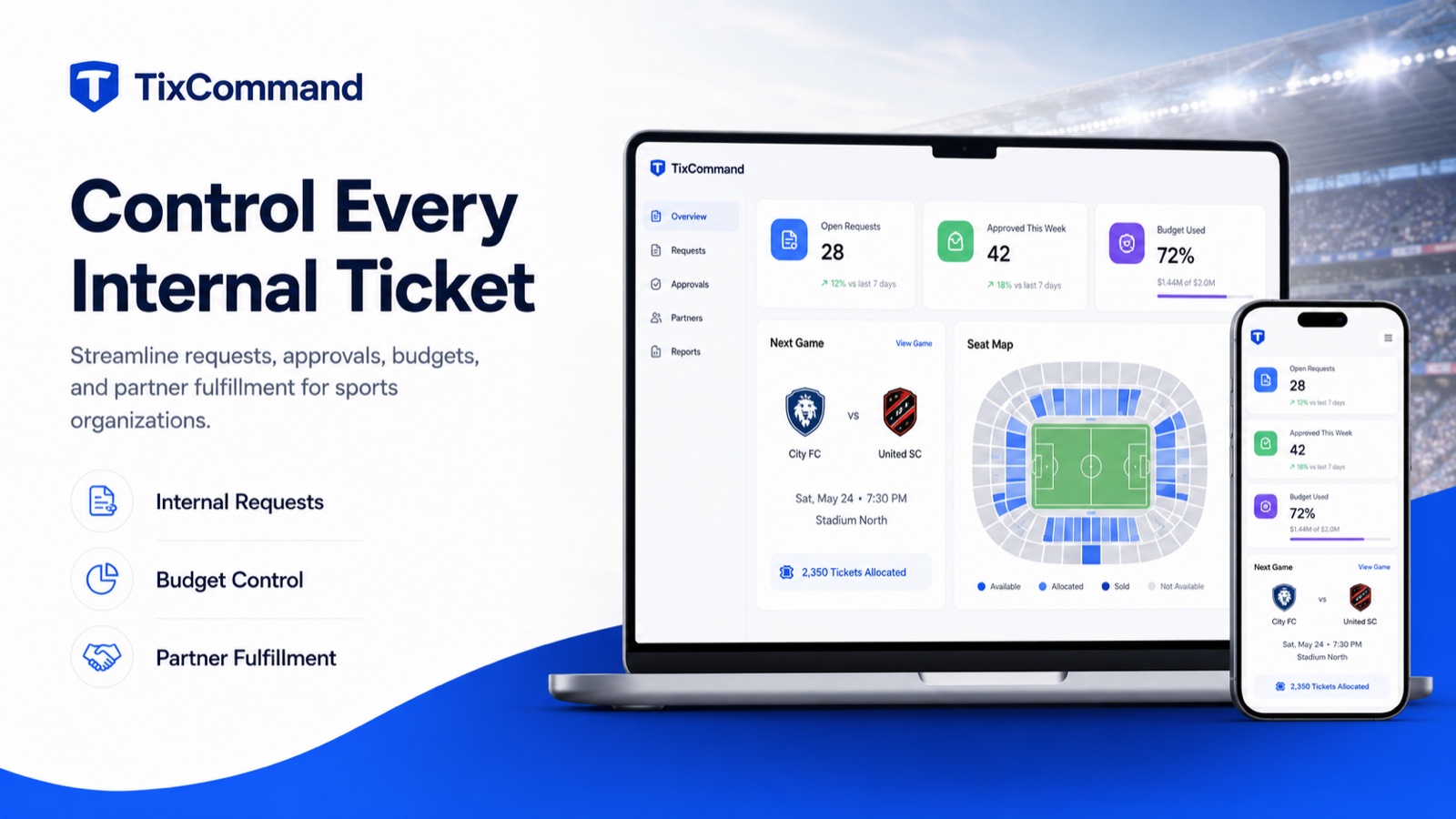
Concept design. Internal requests, budget position and partner fulfilment in one view rather than three spreadsheets. Fixtures, partners and figures shown are illustrative.
The request, and the authority behind it
A request captures the fixture, the purpose, the quantity, the requester and the cost centre it belongs to.
Approval routes on the organisation's authority rules rather than on who happens to be asked, which is the difference between a policy and a habit. A request for two seats for client entertainment and a request for twenty for a community programme are not the same decision, and the routing should reflect that without anyone having to remember it.
The state most worth capturing is the one people skip: what was decided and why. An approval with no recorded reason is indistinguishable from an approval nobody thought about, and only one of those survives a question a year later.
Comp governance as configured rules
Per-game limits, recipient eligibility, documentation requirements, authorisation thresholds.
These are organisational policy, not product logic — they vary by organisation, competition and jurisdiction, and a platform that shipped its own version would be wrong for most users immediately. What the platform does is check the request against the configured rule at the point it is made, and raise an exception when it does not pass.
An exception is a decision for a person, not a block. Legitimate reasons to exceed a limit exist, and the useful behaviour is to make the exception visible and attributable rather than to prevent it and push the request back into an email.
Budgets that are visible during the season
Every allocation draws against a defined budget by department, and the position is available while the season is running.
That timing is the whole point. Comp tickets rarely generate an invoice, so they never enter the finance approval workflow and never acquire the control that workflow provides. The result is that the true position emerges at the end of a season, when nothing can be done about it.
Sponsor and partner entitlements
Contracted allocation, issued against it, remaining. Plus a view the partner can see for themselves.
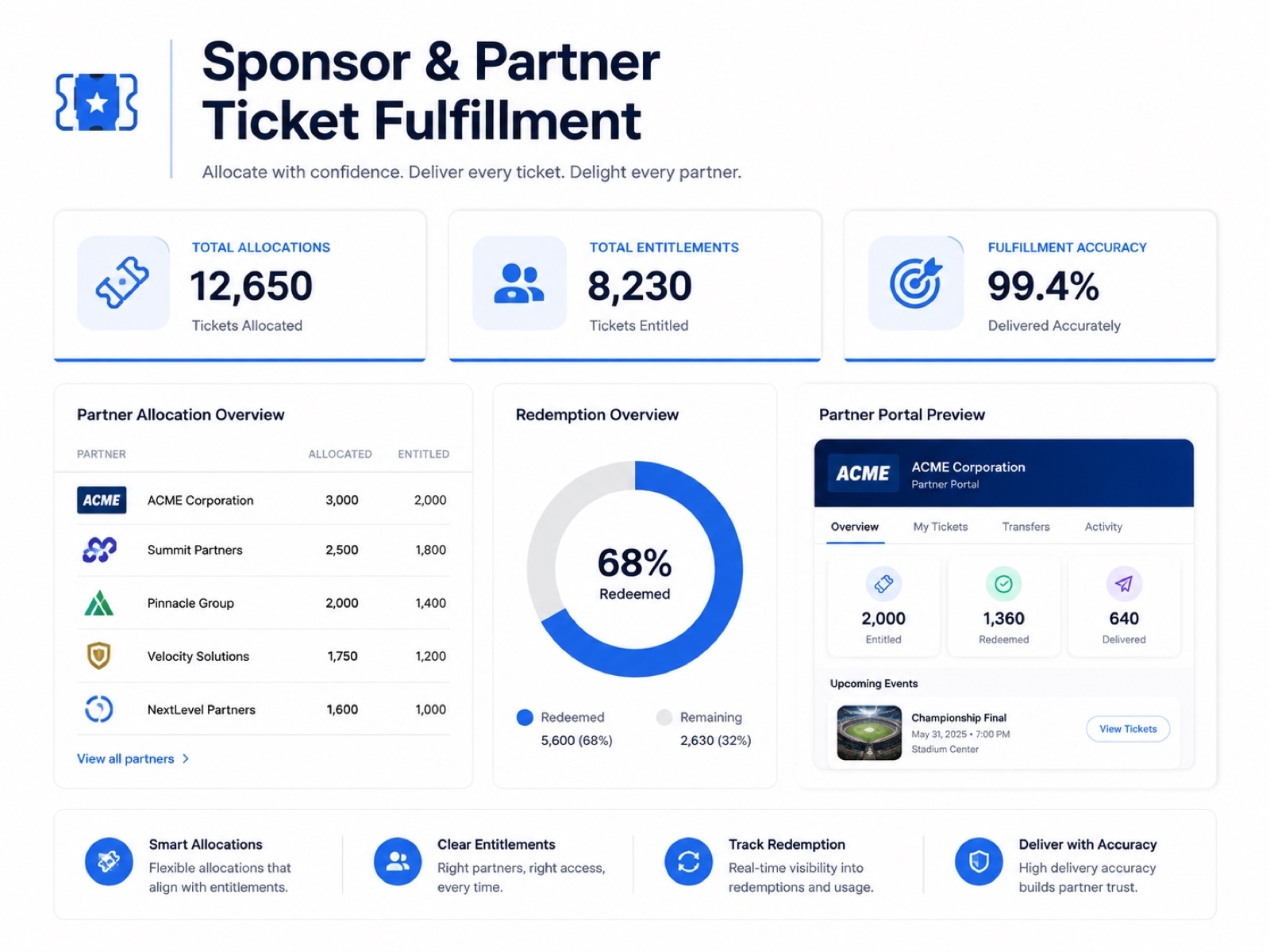
Concept design. Contracted entitlements against what has actually been issued and redeemed, with a partner-facing view. Partners and figures shown are illustrative.
The failure this prevents is specific and common: an entitlement negotiated months ago, tracked by the person who negotiated it, discovered in the closing weeks of a season either undelivered or delivered twice. Both are commercial problems and the first is a contractual one.
Separating issued from redeemed matters here for the same reason it does in any fulfilment workflow. Tickets sent and tickets used are different numbers, and only the gap between them tells you whether the entitlement was worth what the partner paid for it.
The record at the end
Requester, purpose, quantity, cost centre, approver and their authority, the rule applied, any exception and who resolved it, and the issuance outcome.
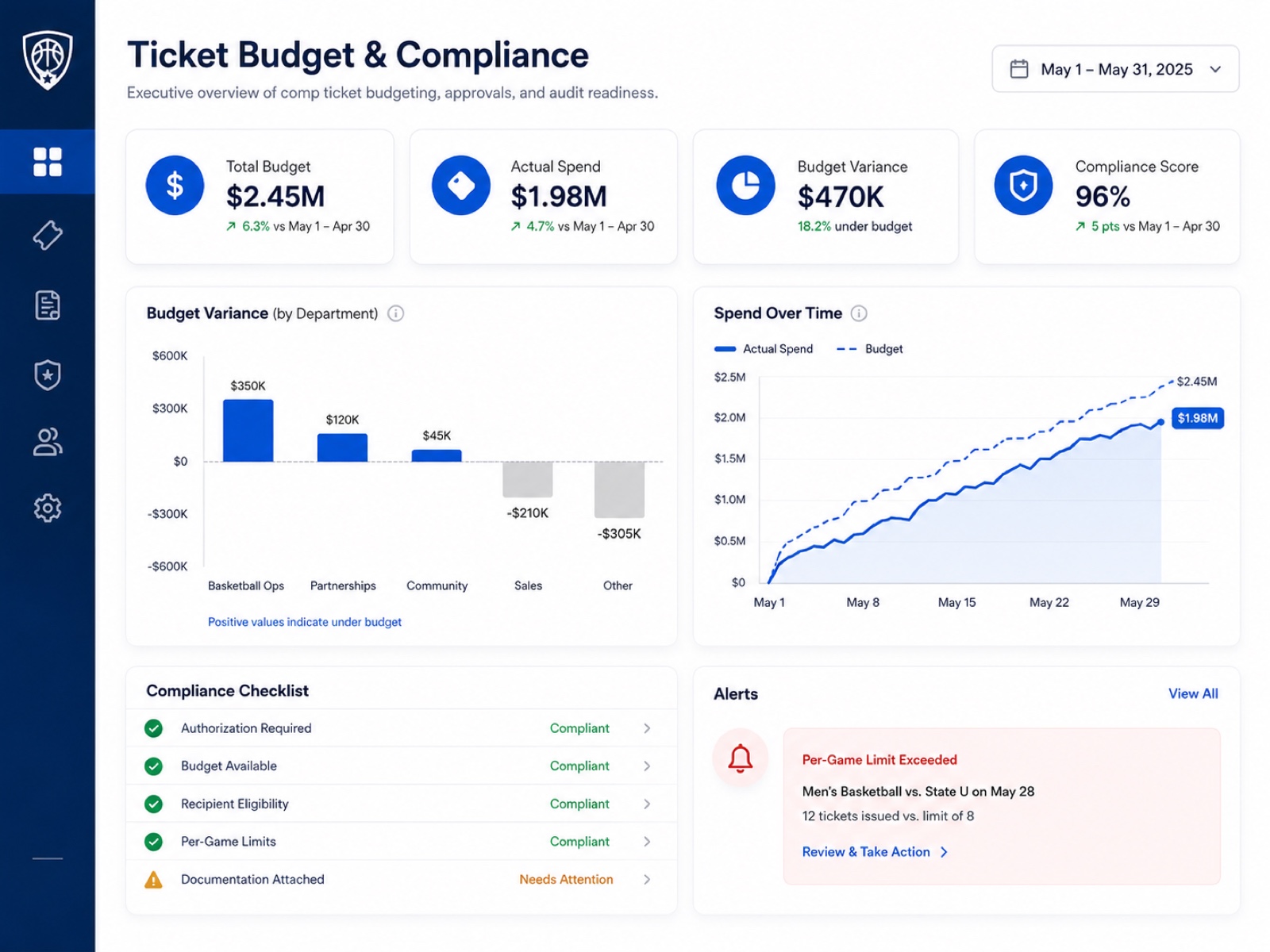
Concept design. Budget position by department alongside the governance checks and their exceptions. Departments, figures and compliance scores shown are illustrative.
Whether a particular allocation was appropriate, or whether it constitutes a taxable benefit anywhere, is not something the software judges. Those are questions for finance and legal. What it provides is the fact pattern any such assessment needs and which is almost always the missing part: who received what, when, on whose authority, and for what stated purpose.
Where the boundary sits
It does not sell tickets, hold inventory, set prices or replace the ticketing platform. It does not deliver the ticket asset, and a first version can record issuance rather than automate it.
It governs the decision that happens before any of that, which is currently the least controlled thing a commercial department does.
Questions we get asked
Does this replace our ticketing platform?
No. The ticketing platform keeps inventory, pricing, sales and the ticket asset itself. This governs the allocation decision that happens before any of that: who asked, on what basis, who approved it, against which budget and under which rule. The two connect at issuance, and a first version can work perfectly well with issuance recorded rather than automated.
Why not just use the finance approval system for this?
Because a complimentary ticket usually has no invoice, so it never enters the finance workflow and therefore never gets the control that workflow provides. That is precisely why comp tickets are the least governed thing a commercial department hands out, and why the position is only ever discovered at the end of a season.
Where do the comp rules come from?
The organisation, always. Per-game limits, who is eligible to receive, what documentation is required and what value needs a higher authorisation are policy decisions that vary by organisation, competition and jurisdiction. The platform checks a request against the configured rule and raises an exception for a person to resolve. It does not invent the rule and it does not decide the exception.
How does this handle sponsor and partner entitlements?
As records with a contracted quantity, what has been issued and what remains, so the gap is visible while there is still season left to close it. The failure this prevents is the common one: an entitlement negotiated months earlier, tracked by the person who negotiated it, discovered in the final weeks either undelivered or delivered twice.
What does an auditor actually get?
A record per allocation showing the requester, purpose, quantity, cost centre, the approver and their authority, the rule applied, any exception and who resolved it, and the issuance outcome. The value is not that the software judges whether the allocation was appropriate. It is that the question can be answered at all, from a record rather than from an inbox.
Is a comp ticket a taxable benefit or a compliance risk?
That depends on the jurisdiction, the recipient and the organisation's own rules, and it is a question for finance and legal rather than for a product page. What the platform contributes is the underlying fact pattern - who received what, when, on whose authority and for what stated purpose - which is what any such assessment needs and what is usually missing.
Build this with SportsFirst
We work with teams, leagues, federations and venues to build custom sports software. Learn about our custom development services or read our sports app cost guide.
Is this your workflow?
Tell us one sports workflow that still runs on paper, spreadsheets, WhatsApp or an outdated system. We will map it and show you what a simpler product looks like.
Tell us about itMore in Ticketing, memberships & season passes
- Hospitality Sales Software for Sports OrganisationsAn AI-assisted premium hospitality sales workflow that answers common questions, qualifies high-value enquiries and gives sales representatives a structured lead instead of a generic form submission.
- Season Ticket Management Software for Sports Teams & VenuesSeason ticket management software that joins ticketing, CRM and access-control records into one account view, then runs renewal campaigns, utilisation and renewal-rate analytics, application and failed-payment recovery, seat changes and fulfilment tracking around the ticketing platform a club already uses.
- Sports Ticketing Software for Clubs, Leagues and VenuesSports ticketing software that sells single-match and season tickets from one seat model, with pricing tiers, mobile entry, in-platform transfer and a fan profile the club owns.
- Digital Game Sheet App for Sports LeaguesA match-day digital game sheet connecting today's fixture, the participating players, waiver status, live goal and card capture and the final official match report, without becoming a league management platform.
- Sports Calendar Marketing Platform for Teams & LeaguesA sports calendar marketing platform that turns fixtures and events into live, subscribable calendar feeds that stay correct when schedules change.
- Creative Workflow Management for Sports Content TeamsA creative request management tool that turns matchday design requests into a visible, owned queue instead of a stream of messages that can be missed.
- Customer Complaint Management Software for Supporter ServicesComplaint management that assigns every complaint to a named owner with a visible response clock, tracks the promises agents make on calls, links repeat contacts to the case already open, and flags accessibility deadlines before they breach.
- Customer Service Software for Sports OrganisationsA fan service recovery workflow that turns important supporter feedback into assigned, trackable cases so problems are resolved instead of disappearing inside survey exports.