Sports Calendar Marketing Platform for Teams & Leagues
By Arpan Desai, Founder, SportsFirst
A sports calendar marketing platform that turns fixtures and events into live, subscribable calendar feeds that stay correct when schedules change.
Problem
Sports organisations publish fixtures, ticket on-sales, hospitality windows, fan events, camps, sponsor activations and venue events across websites, social posts, email and apps. Those channels expire, while the underlying date can still change. The damaging case is not that a supporter misses a post. It is that the organisation published one kickoff time, the fixture moved, and the supporter still has the old time written in their personal calendar.
Product idea
A sports calendar marketing platform that ingests events from the system that already owns them, renders branded schedule experiences across web and app, and lets supporters subscribe to live calendar feeds by team, competition or interest. A subscription remains updateable, so rescheduling, venue changes and postponements propagate to the fan's calendar. The platform can add useful reminders, ticket or broadcast actions, consent capture and subscriber analytics without turning the subscribed calendar into unrestricted promotional inventory.
Where the AI agent does the work
The mechanism worth building is the propagation itself: when the authoritative fixture source changes a kickoff time or venue, the update reaches every subscribed fan's own calendar through the live feed, instead of the organisation posting a correction across several channels and hoping the fan who wrote down the old time sees it. That is what closes the specific failure the problem describes — a supporter turning up against a kickoff time that moved after they last checked. It is propagation, not judgement: the platform distributes what the fixture system already says, and does not decide the schedule or which fans should be told something beyond it.
- Roles involved
- Head of fan engagement, CRM manager, Marketing manager, Digital product manager
- Relevant to
- Professional club, League office, Federation / governing body, Venue & stadium operator, Collegiate athletics, Academy & youth
- Systems in play
- Competition and fixture systems, Ticketing platforms, CRM, Marketing and email platforms, Content management systems
Explored in depth
- Sports Fan Engagement Platform for Interactive Campaigns
A no-code sports fan engagement platform for clubs, leagues, federations, collegiate programmes and sponsors to create polls, predictions, quizzes, competitions and branded campaigns, capture consented fan data, and measure sponsor performance without rebuilding each experience from scratch — supported by a functional concept prototype.
Sports is unusually calendar-driven.
Fixtures move. Broadcast selections alter kickoff times. Postponements happen. Ticket on-sales have deadlines. Hospitality windows close. Camps, fan events and sponsor activations all depend on a date somebody needs to remember.
A sports calendar marketing platform treats the calendar as a durable distribution surface rather than another place to paste a static schedule.
Subscription, not a one-time download
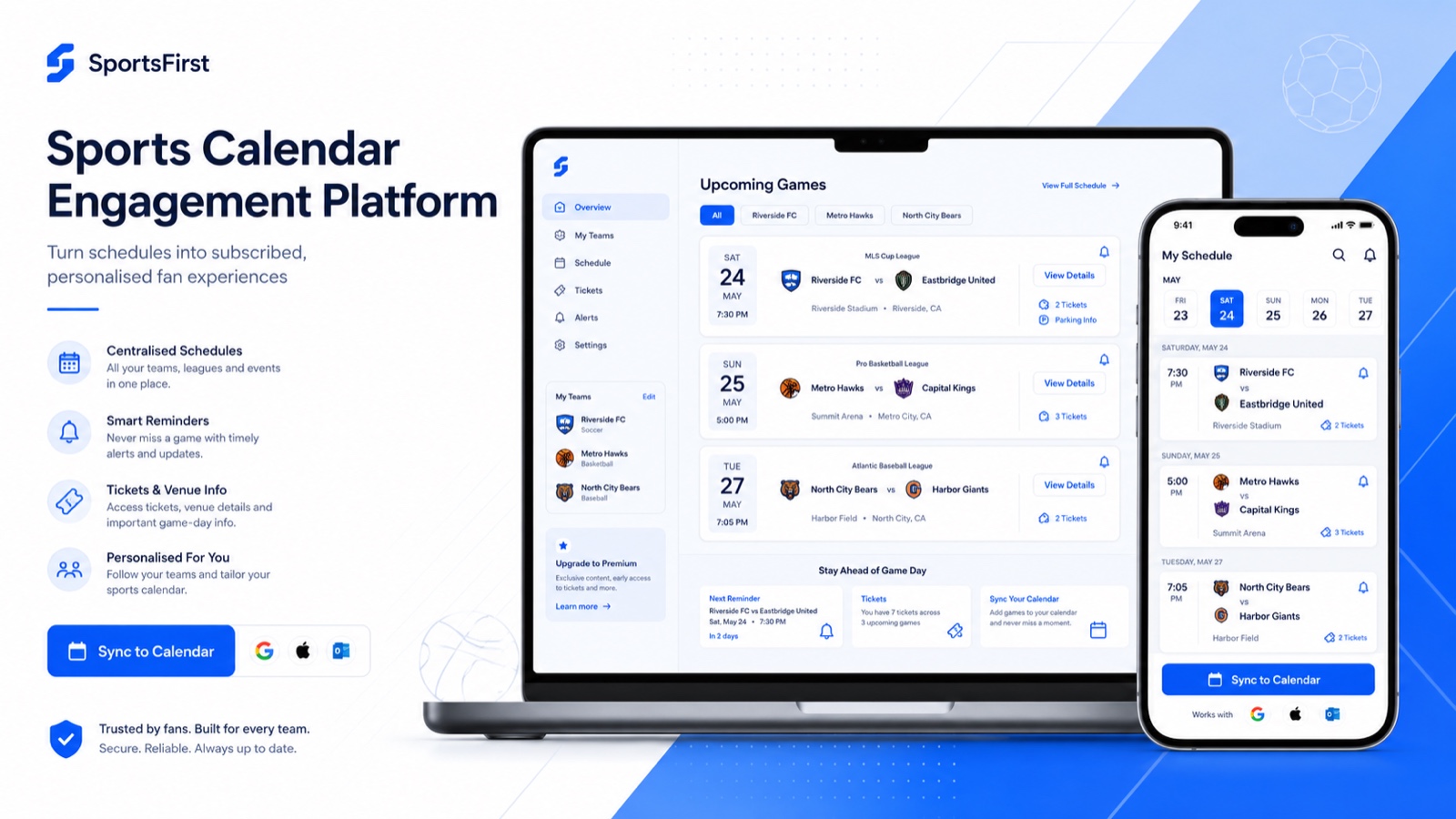
Concept design. Schedule discovery, reminders, ticket context and calendar subscription in one flow. Teams, fixtures and interface copy shown are illustrative.
The product only earns its complexity if it preserves the connection after the supporter first adds the schedule.
A one-time event download writes a copy into the fan's calendar.
A live subscription keeps a relationship between the event source and that calendar entry.
When a kickoff moves, venue changes or fixture is postponed, the subscriber can receive the corrected information without hunting for a new post or email.
That update loop is the core product.
Keep one authoritative fixture source
The calendar platform should not become another competition-management system.
Whichever system already owns the official fixture stays authoritative.
The calendar layer ingests:
- stable event ID;
- competition;
- teams / participants;
- home / away status;
- round;
- start and end time;
- timezone;
- venue;
- event status;
- ticket URL;
- broadcast URL or information where approved;
- last-updated timestamp.
A stable event identifier matters because a rescheduled match should update the existing event rather than create a duplicate.
Publish the same schedule across surfaces
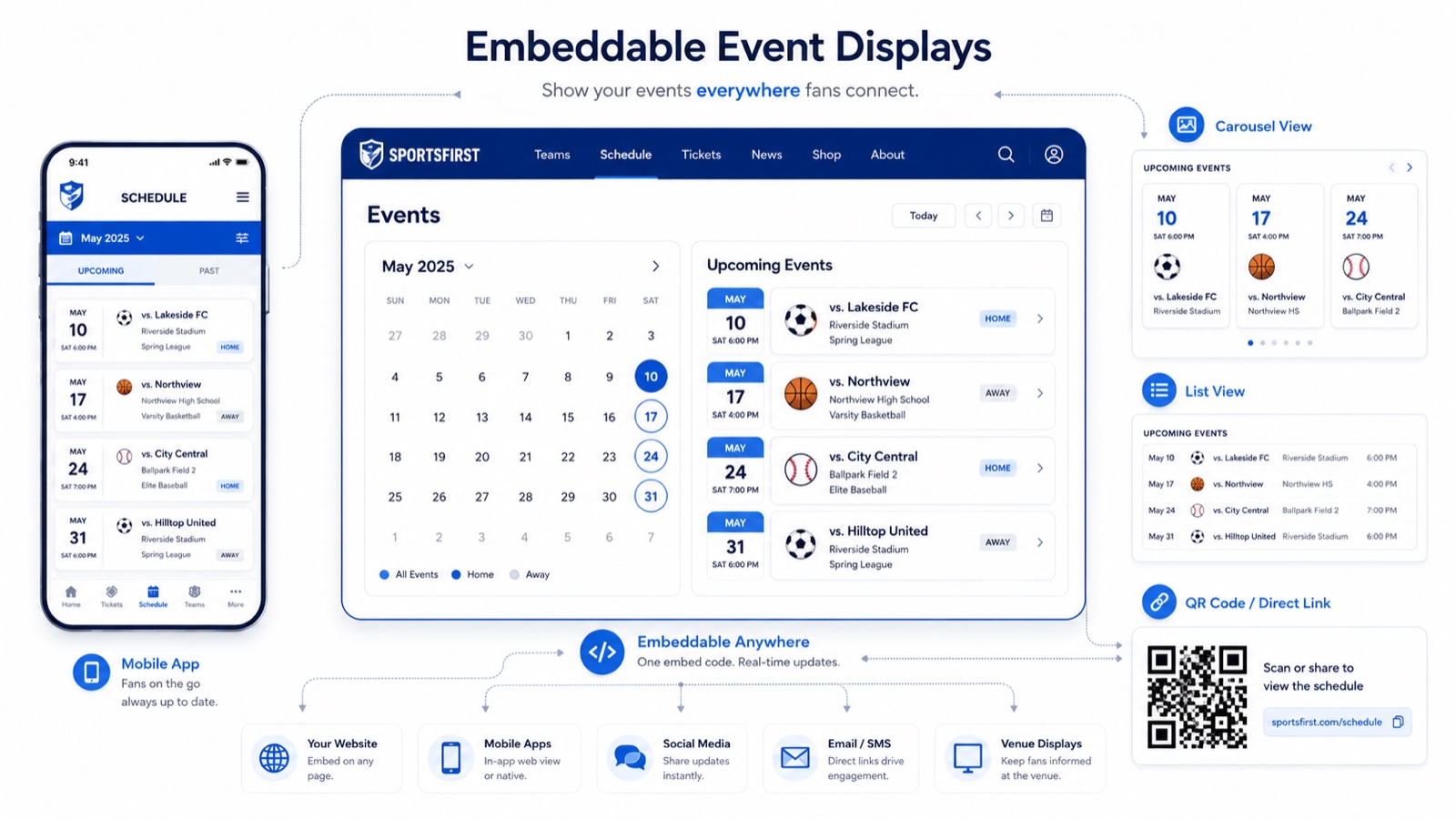
Concept design. One event dataset rendered as calendar, list and carousel views, embeddable across web, app, social and venue surfaces.
The same event data can render as:
- full calendar;
- upcoming-event list;
- fixture carousel;
- compact team schedule;
- campaign landing-page module;
- mobile app web view;
- partner schedule;
- QR-linked schedule;
- direct subscription page.
The design changes by surface. The underlying fixture does not.
That reduces the common problem where the website, app and campaign page each contain a separately maintained version of the same date.
Let supporters choose what they follow
A league-wide feed is often too noisy.
Subscription choices can include:
- one team;
- one competition;
- home fixtures;
- selected venue;
- ticket on-sales;
- fan events;
- camps;
- hospitality events;
- broadcast reminders.
The supporter should understand what subscribing means before the feed is added.
The selected stream also becomes a useful first-party preference signal, provided it is handled within the organisation's consent and data policies.
Reminder logic should be useful
A reminder earns its place when it helps the supporter act.
Examples:
- fixture tomorrow;
- venue gates open in two hours;
- ticket on-sale window opens;
- broadcast starts in 30 minutes;
- parking or travel information;
- event venue changed;
- postponement confirmed.
The product should resist the temptation to treat every calendar entry as marketing inventory.
A fan who subscribed for fixtures did not automatically ask for unrelated offers.
Ticketing and broadcast actions
Calendar events can contain approved actions such as:
- buy tickets;
- manage tickets;
- view hospitality;
- open venue guide;
- watch / listen;
- view match centre;
- add parking;
- read travel information.
Those links can make the calendar useful beyond reminding someone of a date.
They also create measurable downstream engagement without claiming that the calendar alone caused the final purchase.
Update propagation needs an operational SLA
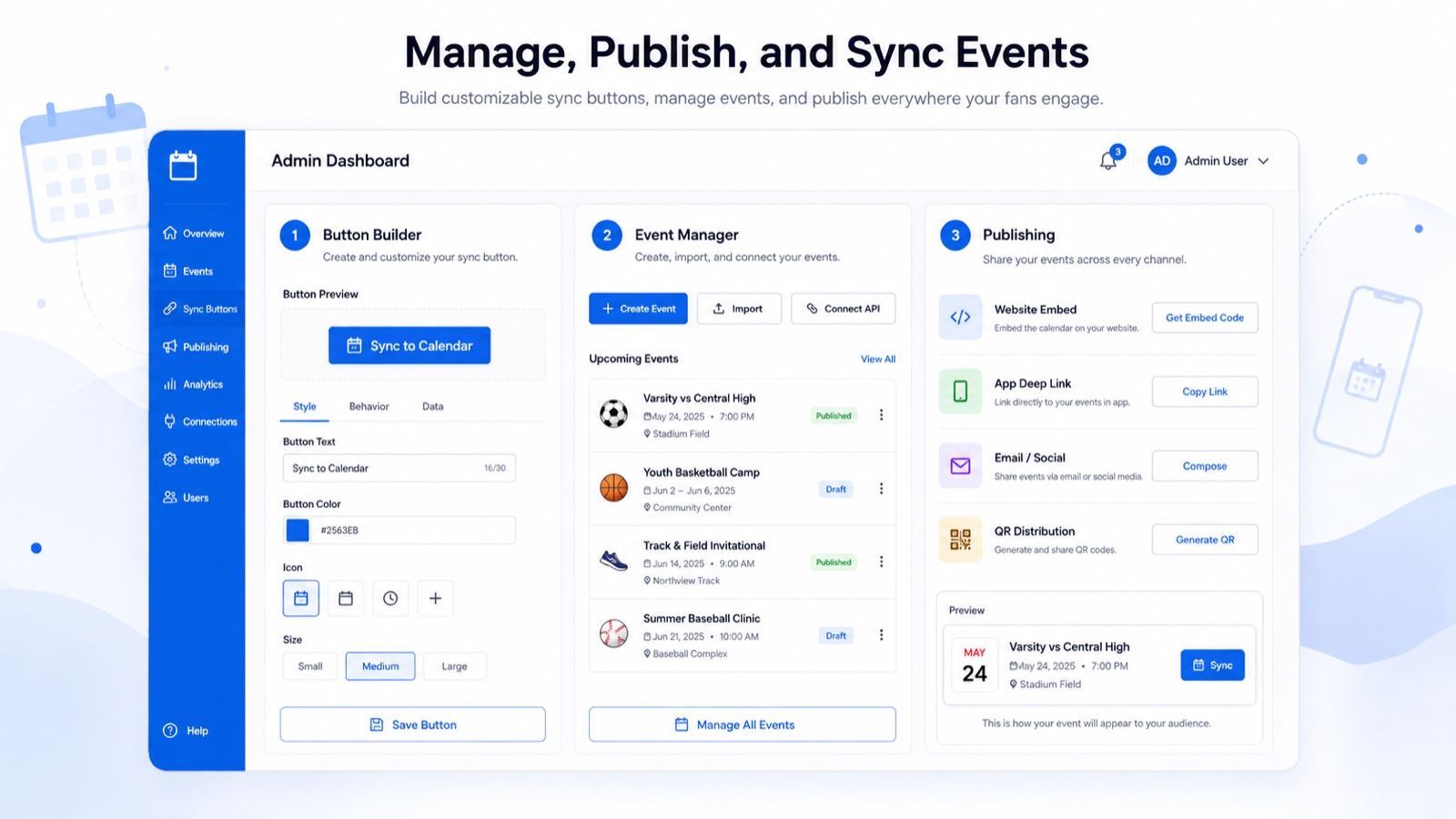
Concept design. The operational side: manage events, configure the subscribe experience and publish across channels without rebuilding the content each time.
The technical question is not only whether an event can update.
It is how quickly a changed source fixture reaches:
- the calendar platform;
- the subscriber feed;
- the calendar provider;
- the fan's device.
A production build should measure the first two directly and document the parts controlled by third-party calendar clients.
For high-risk updates such as postponements, the platform should show the source timestamp and the distribution status to the operations team.
Timezones and international fans
Sports schedules are consumed globally.
Store the authoritative event time with an explicit timezone and render it in the subscriber's calendar according to the calendar provider's timezone behaviour.
Do not bake a localised display time into a field that is meant to represent the event's actual timestamp.
Timezone handling deserves dedicated test cases around daylight-saving changes, international competitions and fixtures announced before a final local start time is confirmed.
Subscriber data and consent
A calendar subscription can create a valuable signal of intent.
That does not mean the platform needs a large personal profile.
A first version may only need:
- subscription identifier;
- chosen stream / interests;
- consent record where required;
- source / campaign;
- created date;
- active / unsubscribed status;
- engagement events allowed by the implementation.
Keep the data model proportionate to what the product actually does.
What to measure
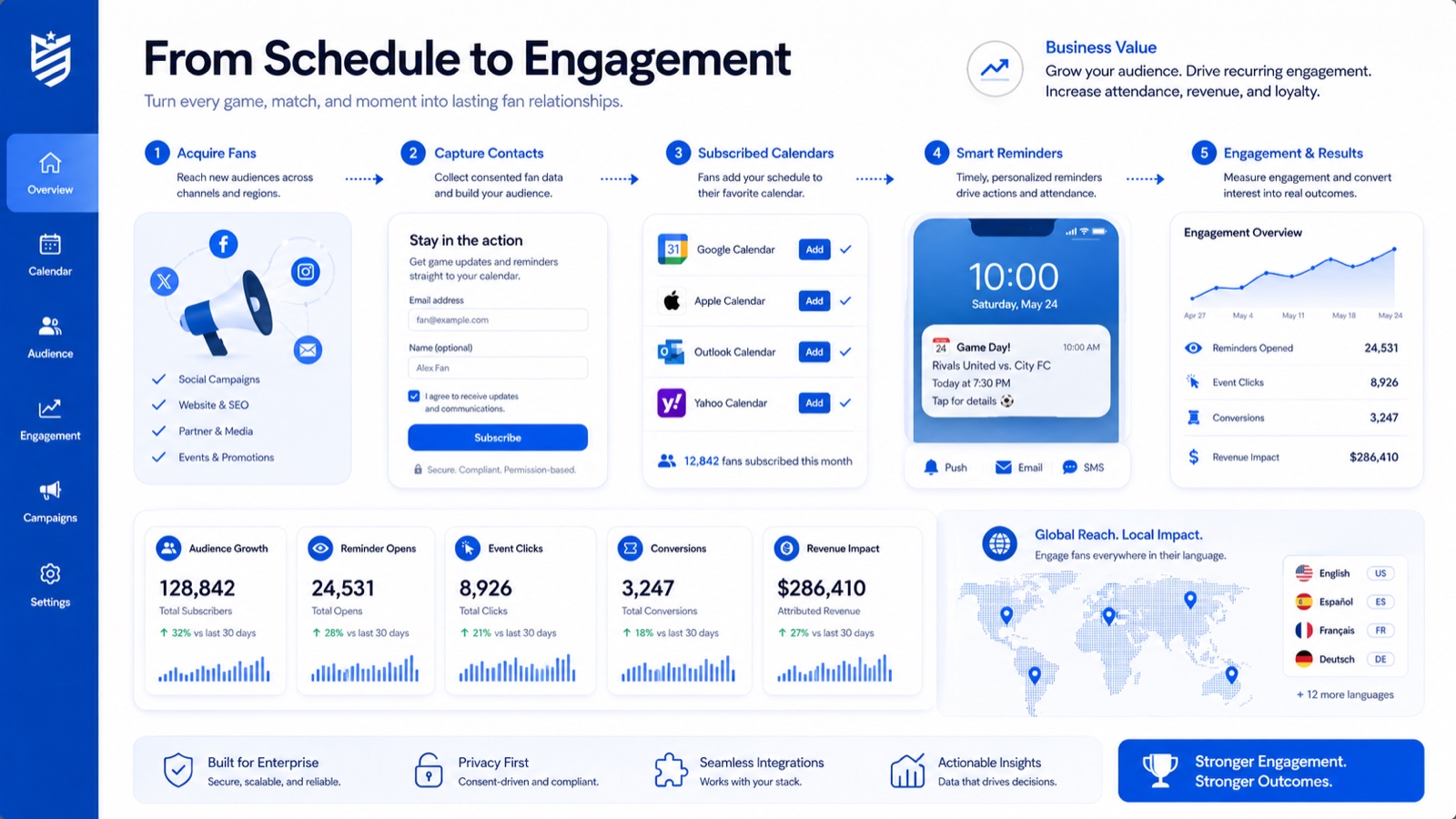
Concept design. The intended lifecycle: event data becomes subscriptions, subscriptions become reminders, and reminders become measurable actions worth reporting.
Useful metrics include:
- total active subscribers;
- subscriber growth;
- subscription source;
- team / competition preference;
- retention through a season;
- reminder interactions;
- click-through to ticketing;
- click-through to broadcast;
- click-through to venue information;
- unsubscribe rate;
- event update success;
- update latency.
The platform can show that a subscriber clicked from a calendar event to a ticket page.
It should not automatically claim that the reminder caused a ticket purchase unless the organisation has implemented an appropriate attribution or experiment design.
A sensible first phase
Phase 1 — Event model
Define the event types, authoritative source, stable identifiers, timezone rules and update ownership.
Phase 2 — Publishing
Create the branded subscribe experience and reusable list, calendar and carousel components.
Phase 3 — Live subscription
Generate feed subscriptions and validate rescheduling, postponement and venue-change behaviour.
Phase 4 — Distribution
Add web/app embeds, QR codes, deep links and campaign entry points.
Phase 5 — Measurement
Track subscriber growth, chosen streams, retention and downstream engagement.
What it should not become
It should not become a replacement fixture database.
It should not edit a supporter's unrelated personal calendar.
It should not infer broad marketing consent from a schedule subscription.
It should not create a second manually maintained schedule.
The product is valuable because the date the organisation publishes remains correct in the place the supporter chose to keep it.
Questions we get asked
How is a calendar subscription different from an add-to-calendar button?
An add-to-calendar action usually creates a fixed copy of one event. A subscription is a live feed. When the source fixture changes, the subscribed event can update without the supporter finding and importing a replacement event.
Does this replace our competition or fixture system?
No. The existing fixture system stays authoritative. The calendar platform distributes and renders its events. Maintaining the same fixture manually in two systems is exactly the problem the product should avoid.
Can we put promotions into a fan's calendar?
Only within the scope the supporter actually chose. A fixture subscription should remain a fixture subscription. Commercial communications need a clear, separate basis and should not turn a trusted schedule feed into another unsolicited marketing channel.
What can we measure?
Subscribers, growth, source of subscription, selected interests, retention, reminder interactions and clicks to ticketing, broadcast or other approved actions. A click can be measured; causally attributing a ticket sale to one reminder needs a more careful experiment.
What data do we need for version one?
One reliable event source, stable event identifiers, title, start and end time, timezone, venue, status and update ownership. A spreadsheet can be enough for a pilot if one person owns its accuracy.
Build this with SportsFirst
We work with teams, leagues, federations and venues to build custom sports software. Learn about our custom development services or read our sports app cost guide.
Is this your workflow?
Tell us one sports workflow that still runs on paper, spreadsheets, WhatsApp or an outdated system. We will map it and show you what a simpler product looks like.
Tell us about itMore in Fan engagement & personalisation
- Sports Fan Loyalty Program Software for Teams & LeaguesSports fan loyalty software connecting attendance, engagement and commerce to points, tiers, milestones, rewards and accountable fulfilment.
- Fan Data Platform for Sports Teams & LeaguesA sports fan data platform that joins ticketing, CRM, app and commerce signals into trusted fan profiles for analytics, identity resolution, segmentation and explainable personalisation.
- Marketing Approval Workflow Software for Sports TeamsApproval workflow software for sports marketing teams, combining campaign intake, legal and sponsor review, audience sign-off, audit trails and bottleneck analytics.
- Sports Camp Registration Software for Youth and Travel ProgrammesSports camp registration software connecting online enrolment, payment, waivers, medical documents, group assignment and parent communication in one workflow, replacing the spreadsheet-and-email process that most youth sports camps still run.
- Sports Digital Asset Management Software for Clubs and LeaguesA sports digital asset management platform that gives clubs and leagues one searchable, rights-aware home for match footage, photography, sponsor assets and social content, with AI tagging replacing folder-and-filename search.
- Sports Digital Asset Management for Video and Match FootageA sports media ingest and tagging workflow that routes match footage to an editor immediately and makes sure it enters the archive with searchable metadata.
- Sports Disciplinary Case Management SoftwareA configurable case workflow for disciplinary administration: intake, owner, stage, rule-derived deadlines, evidence, hearings, decisions, notification and appeals, with the finding itself left to the authorised panel.
- Sports Equipment Inventory SoftwareOne register for kit stock, entitlement-based allocation, issue and return with condition evidence, departure recovery and reorder thresholds, with stock figures that state how current they actually are.