Digital Game Sheet App for Sports Leagues
By Arpan Desai, Founder, SportsFirst
A match-day digital game sheet connecting today's fixture, the participating players, waiver status, live goal and card capture and the final official match report, without becoming a league management platform.
Problem
Adult competitions still run match day on paper game sheets, emailed forms and a report somebody types up afterwards. Staff need to know which games are on, which players are actually taking the pitch, whether the required waivers are signed, what happened during the match and what the official record should say. Because those steps live in different places, the same names get entered three times: once on the team sheet, once on the scoresheet, once in the report. A player added at the last minute has a waiver chased by email while the game is starting, and nobody can say afterwards whether it was signed before or after they played. The final record is assembled from a sheet of paper that has been in the rain, and reconciling it against what the competition office thinks happened takes longer than the match did.
Product idea
A deliberately narrow match-day app for tablet, phone and web that follows the actual sequence of a game rather than a database schema. Staff sign in, open today's fixture, confirm the two teams and the players taking part, and see waiver status against each name as they do it. A player who needs adding gets a waiver link by email, completes a mobile form and moves from pending to signed without anyone leaving the game. During the match the interface becomes a live game sheet capturing only what the official record needs: field goals, penalty-corner goals, penalty-stroke goals, and green, yellow and red cards, each against a team, a player and a match time, with the running score. At the final whistle the report assembles itself from what was already entered. It is a digital game sheet, not a league management platform, and it does not decide eligibility or establish that a waiver is legally enforceable.
Where the AI agent does the work
The agent's job is narrow: watch each added player's waiver from pending to signed and chase the ones still open. Today that chase happens by email while the game is already starting, with nobody able to say afterwards whether a signature landed before or after kickoff. The agent sends the reminder the moment a name goes on the sheet, tracks whether it was opened and signed, and surfaces anyone still pending as the players walk out, instead of a staff member remembering to check an inbox mid-match. It also drafts the closing report from the events already captured rather than someone retyping a rain-damaged paper sheet, so the post-match write-up that used to take longer than the match itself is a read-back, not a rebuild.
- Roles involved
- Competition manager, Technical official, Match official, Scorekeeper, Team manager
- Relevant to
- League office, Federation / governing body, Professional club
- Systems in play
- Paper game sheets, Spreadsheets, Email waiver forms, Standalone scorekeeping apps
A proposal worked through in full
A different problem, taken all the way to architecture, standards and a phased delivery plan — the level of detail any idea here can be developed to.
Sports Fan Engagement Platform for Interactive CampaignsA match-day workflow that runs on a paper sheet, an email thread and a report typed up on Sunday evening is not short of software. It is short of one place where the sequence actually happens.
This is not a problem unique to one sport. Any competition that produces an official match record — goals or points by type, cards or fouls, participating players, a final report the league accepts — runs the same sequence and loses it in the same places. What changes between sports is the event vocabulary, which is configuration rather than a different product.
This proposed digital game sheet follows that sequence: today's fixture, the players taking part, their waiver status, the events as they happen, and the official record at the end. There is a clickable prototype of the main screens at match-insights-sportsfirst.vercel.app.
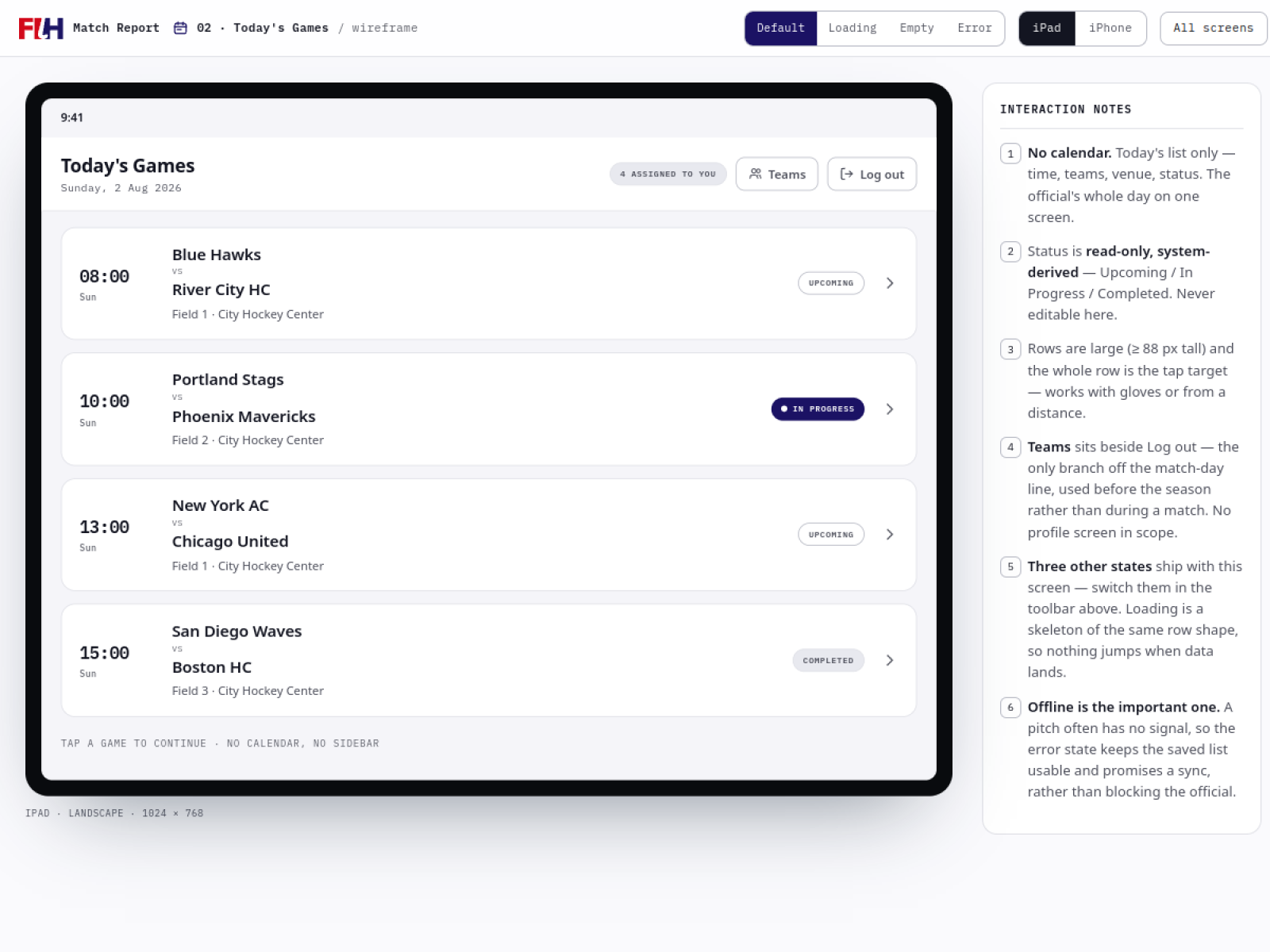
Prototype: staff land on today's fixtures rather than a menu, with each game showing what stage it is at. The prototype is built for field hockey, which is why its events are field goals, penalty corners and penalty strokes; another competition configures its own.
The sequence, not the schema
Staff sign in and see today's games rather than a menu. They open the fixture, confirm the two teams and the players taking the pitch, and the interface then turns into a live sheet for the match itself.
That ordering matters more than any individual feature. Products in this space usually start from a database of teams and players and ask the user to navigate to a game. On a Saturday morning, with a tablet in one hand, the user has exactly one game in mind.
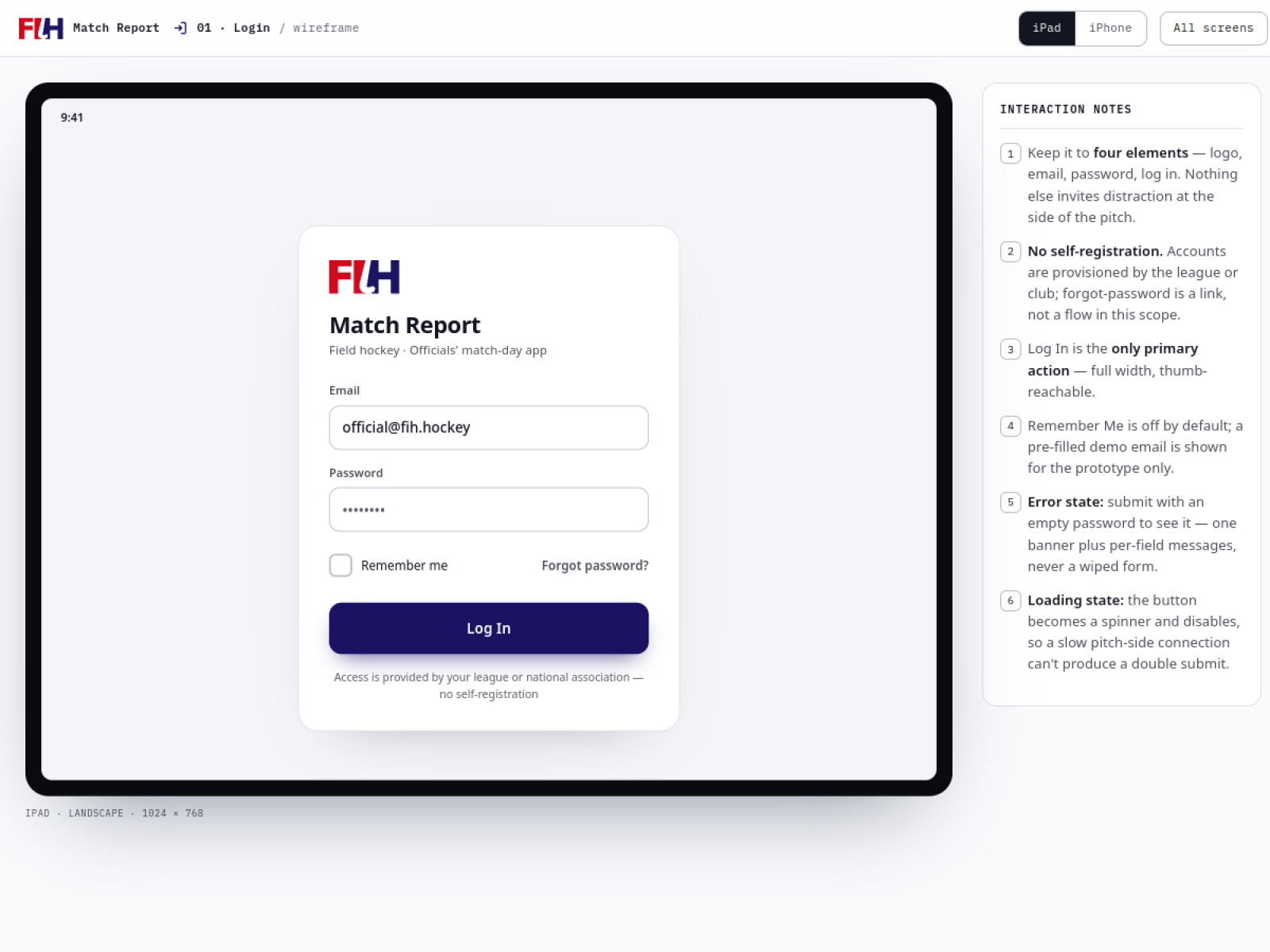
Prototype: sign-in is the whole of the front door. The next screen is already the day's work.
Confirming who is playing
Player information can stay minimal: shirt number, name, and whether they are taking part.
Waiver status sits against each name at this point, which is the only moment it is genuinely useful. A roster that shows signed and pending inline turns a compliance question into a glance rather than a search through a folder of PDFs.
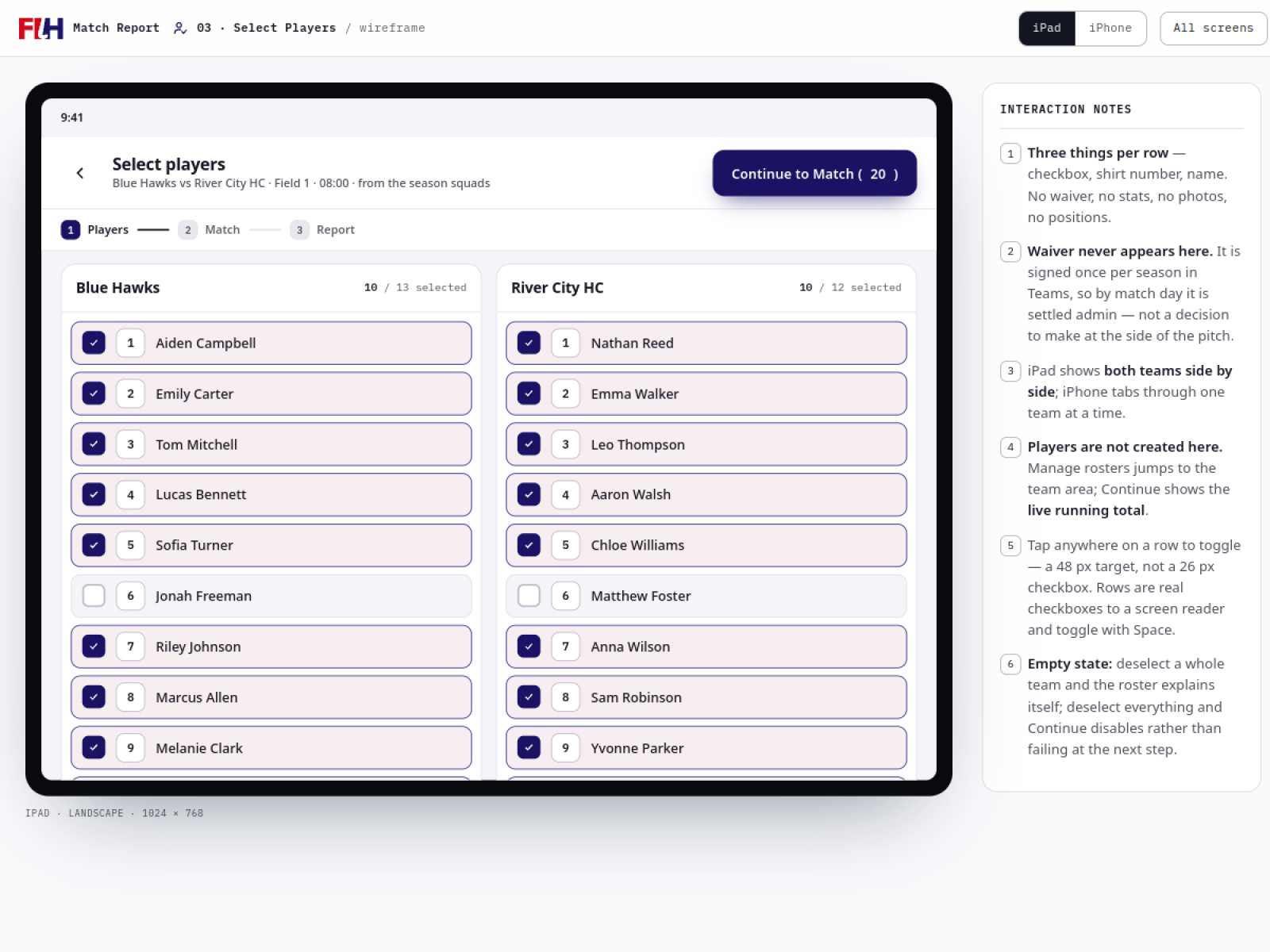
Prototype: the playing roster for both teams, with waiver status against each name before the match starts.
Adding a player, and the waiver that follows
Someone always needs adding. Authorised staff enter a name and an email, the platform sends a waiver link, the player opens a mobile-friendly form, signs, and the roster flips from pending to signed without anybody leaving the game screen.
The operational rule this creates is the valuable part: selected to play, waiver status visible, missing waiver sent, signed record retained, with the submitted document and its timestamp kept.
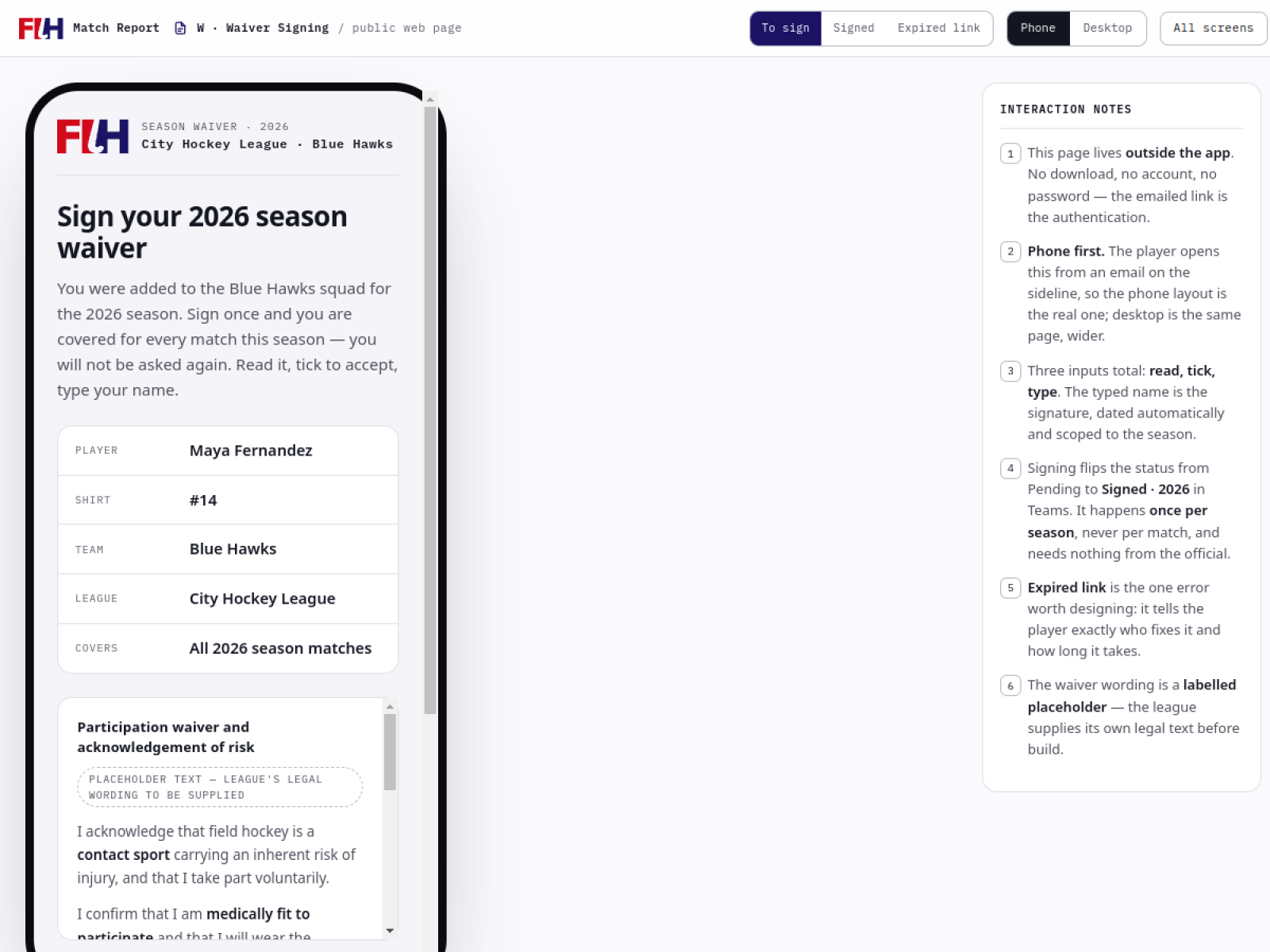
Prototype: a missing waiver is sent and signed without anyone leaving the match-day workflow.
What the product must not do is imply that holding a signed form determines eligibility or establishes that the waiver is enforceable. It records that a document was submitted and when. The rest belongs to the competition's rules and, where it matters, to legal advice.
The live sheet, kept small
During the match the app captures field goals, penalty-corner goals and penalty-stroke goals, and green, yellow and red cards. Each event is a team, a player, a match time and the resulting running score.
That is the whole event model, deliberately. A volunteer scorekeeper should not be tagging dozens of statistics while also watching the game, and the goal here is a correct official record rather than a performance-analysis database. Shot maps, tactical breakdowns and advanced statistics are a different product with a different user, and folding them in is the most reliable way to make this one unusable.
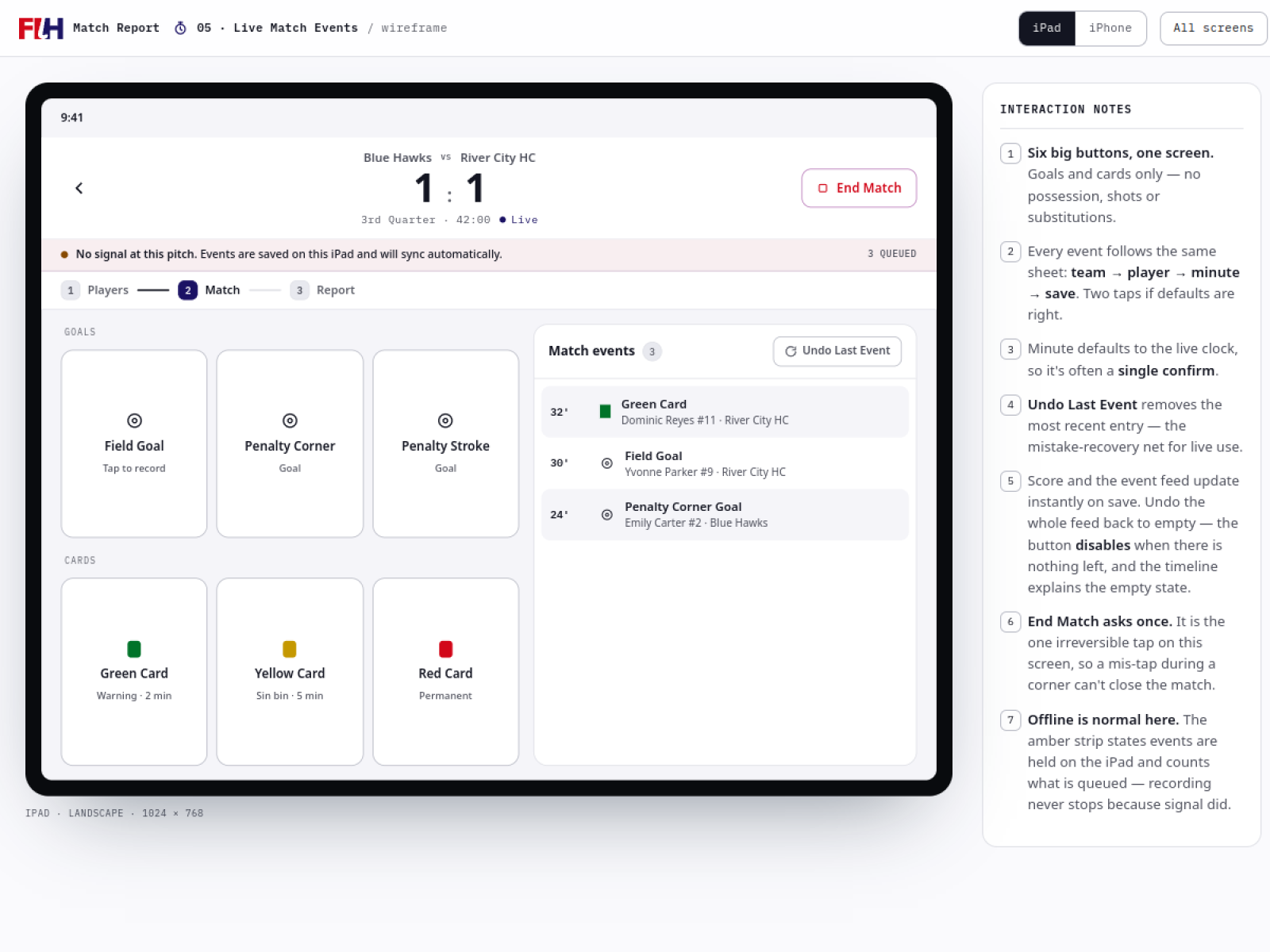
Prototype: six buttons and one screen. Goal types and card colours feed the running score and the event timeline.
The prototype makes the offline case visible rather than assuming it away: events captured with no signal are held on the device, the count of queued events stays on screen, and recording continues regardless.
Offline capture belongs in the first version rather than a later one. Pitch-side connectivity is worst precisely at the venues still running on paper, and a tool that stops working when the signal drops gets abandoned after a single wet afternoon.
The report assembles itself
At the final whistle everything needed for the official record has already been entered, so the report should not require rebuilding.
It carries the match information — date, venue or pitch, competition or pool, match number, teams — the period and final scores, the participating players with shirt numbers, the goals with player, time, type and running score, the cards with player, time and colour, the match personnel, a chronological event timeline and any closing remarks or technical notes the competition requires.
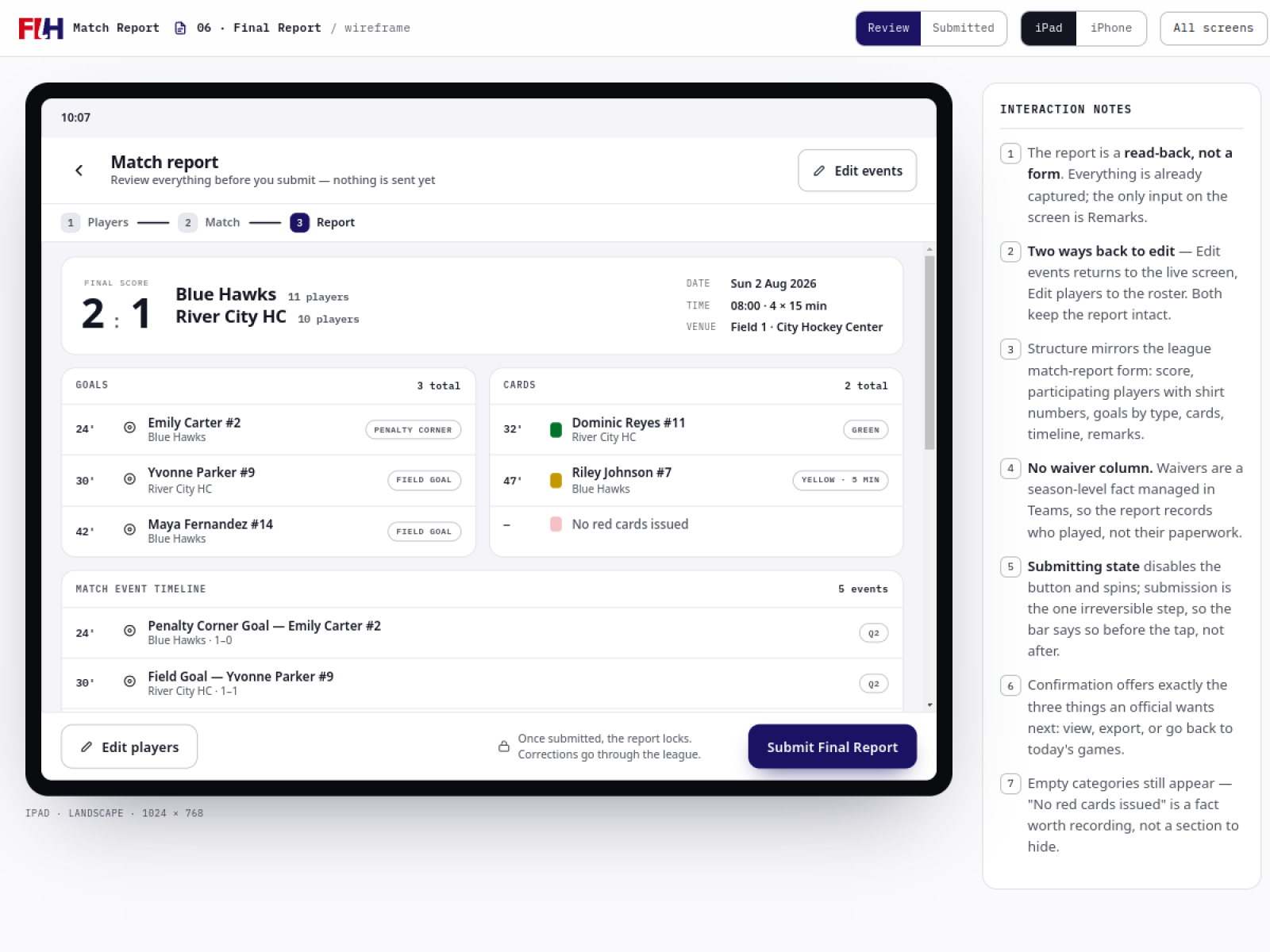
*Prototype: the report is a read-back rather than a form. Everything on it was captured during the game, and submission is the one irreversible step.*Exportable and shareable, without a second pass.
What version one should refuse to become
Registration, payments, standings, scheduling, messaging, analytics, a full league management suite.
Each of those is a reasonable request and each one moves the product away from the thing it does well. The reason a paper game sheet has survived is that it is fast at one job. A digital replacement earns its place by being faster at the same job, not by being a platform that happens to include it.
Where it sits next to the team-sheet workflows
Team-sheet submission, late-change routing and squad eligibility clearance are pre-match administration between a club and a competition office. They answer whether a named squad is permitted to play.
This starts after that question is settled and owns the match record itself: who took the pitch, what happened, what the official result says. The two connect at exactly one point, which is the confirmed roster.
Questions we get asked
Is this a full league management platform?
No, and keeping it out of that category is the point. The first version covers match day only: open the game, confirm who is playing, check or send waivers, record the events that belong on the official record and complete the report. Scheduling, registration, payments, standings and communications can stay wherever they already live, and a competition running well on an existing system for those does not need to move them.
What events should the first version record?
Goals broken down by how they were scored, and the three card colours, each logged against a team, a player and a time. Nothing else. The temptation is to capture shots, circle entries and possession while somebody is already tapping a screen. Resisting it is what keeps the tool usable, because the person holding the tablet is usually a volunteer who is also watching the game.
Why is waiver signing part of a scoring app?
Because the moment it matters is the moment the roster is confirmed. A player added ten minutes before push-back is exactly the player whose waiver is outstanding, and handling that in a separate email thread is how a signature ends up dated after the match. Keeping it in the same flow makes the operational rule clean: selected to play, waiver status visible, missing waiver sent, signed record retained.
Does a signed waiver mean the player is eligible?
No. The app records that a document was submitted and when, which is evidence and not a determination. Whether the waiver is enforceable, and whether the player is eligible under the competition's own rules, are separate questions answered by the organisation and, where it matters, by its legal advice. Conflating the two would be the most damaging thing this product could do.
What happens if the tablet loses connection mid-match?
This is the requirement that decides whether the product survives contact with a pitch. Event capture has to work offline and reconcile afterwards, because pitch-side coverage is unreliable at exactly the venues most likely to still be on paper. A version that assumes connectivity will be abandoned after one wet Saturday.
Can we see it before committing to anything?
There is a clickable prototype covering the main screens, linked in the page above. It demonstrates the workflow and the information architecture; it is a concept prototype rather than a product, and any figures inside it are illustrative.
Build this with SportsFirst
We work with teams, leagues, federations and venues to build custom sports software. Learn about our custom development services or read our sports app cost guide.
Is this your workflow?
Tell us one sports workflow that still runs on paper, spreadsheets, WhatsApp or an outdated system. We will map it and show you what a simpler product looks like.
Tell us about itMore in League & federation administration
- NIL Compliance Software for Sports OrganisationsA configurable NIL compliance workflow for collecting athlete disclosures, supporting documents, approvals and audit-ready records without relying on email and spreadsheets.
- Player Eligibility and Roster Verification SoftwareA workflow that checks every submitted team sheet against registration, suspension and document status automatically, flagging problems to the club before kickoff instead of after a dispute.
- Sports Camp Registration Software for Youth and Travel ProgrammesSports camp registration software connecting online enrolment, payment, waivers, medical documents, group assignment and parent communication in one workflow, replacing the spreadsheet-and-email process that most youth sports camps still run.
- Sports Disciplinary Case Management SoftwareA configurable case workflow for disciplinary administration: intake, owner, stage, rule-derived deadlines, evidence, hearings, decisions, notification and appeals, with the finding itself left to the authorised panel.
- Sports Calendar Marketing Platform for Teams & LeaguesA sports calendar marketing platform that turns fixtures and events into live, subscribable calendar feeds that stay correct when schedules change.
- Sports Digital Asset Management Software for Clubs and LeaguesA sports digital asset management platform that gives clubs and leagues one searchable, rights-aware home for match footage, photography, sponsor assets and social content, with AI tagging replacing folder-and-filename search.
- Facility Scheduling Software for Sports OrganisationsA sports facility scheduling system that gives teams and administrators one reliable view of field, court and training-space availability with conflict checking and self-service booking.
- Football Trial Management Software for Clubs and AcademiesA football trial management software concept that replaces scattered invitation, consent and readiness tracking with one auditable trial workflow.