AI Grant Finder Software for US Sports Organisations
An AI agent that ranks sports grants by estimated funding likelihood for a specific organisation, drawn from over $450M in tracked US awards and program frequency, with a drafted first-pass application per match.
Problem
Sports grant databases return long lists of technically open opportunities with no sense of which ones a specific organisation could actually win. A club or league searching "youth sports grants" gets hundreds of results filtered by category and location at best, with no signal on how often a given funder actually awards to organisations like theirs, how competitive the program has historically been, or whether the eligibility language quietly rules them out. Program directors spend hours reading award criteria for grants they were never a realistic candidate for, and the smaller, recurring, less-publicised programs that make up most of the money awarded to youth and grassroots sport get missed entirely because they never rank on a generic list.
Product idea
An AI grant finder agent built on a tracked history of over $450 million in grants already awarded to US sports organisations, including which programs fund repeatedly, how often, and to what kind of organisation. Given a club, league or federation's profile, the agent returns grants ranked by estimated funding likelihood, not just topical match, drawing on program frequency and prior award patterns rather than eligibility text alone. It can also draft the initial application narrative from the organisation's own information. It does not submit applications, guarantee an award, or make eligibility determinations that belong to the funder.
Where the AI agent does the work
The expensive step in grant seeking is not writing the application, it is deciding which of hundreds of open programs are worth the hours an application takes. The agent reads an organisation's profile once and ranks grants against a history of over $450 million already awarded, surfacing the funder that quietly gives to a dozen small leagues a year ahead of the prestigious national program that has funded three organisations in a decade and was never a realistic target. A program director spends the freed time on the two or three applications actually worth finishing, instead of skimming eligibility criteria for forty.
- Roles involved
- Club secretary, League administrator, Grant writer, Program director, Partnerships manager
- Relevant to
- Academy & youth, League office, Collegiate athletics, Federation / governing body
- Systems in play
- Grants.gov and foundation portals, Spreadsheets and email, Club or league websites, Document and application storage
Explored in depth
- Sports Sponsorship Activation Platform for Interactive Live Streaming
A sports sponsorship activation platform that turns rights-cleared alternate live camera feeds into sponsor-branded second-screen experiences with interactive streaming, polls, predictions, rewards, consented fan data and measurable sponsor reporting.
A generic grant search returns hundreds of results for "youth sports grants" and treats a program that funds one organisation nationally every three years the same as one that quietly awards to a dozen small leagues every year. Nothing in that list tells a program director which is which.
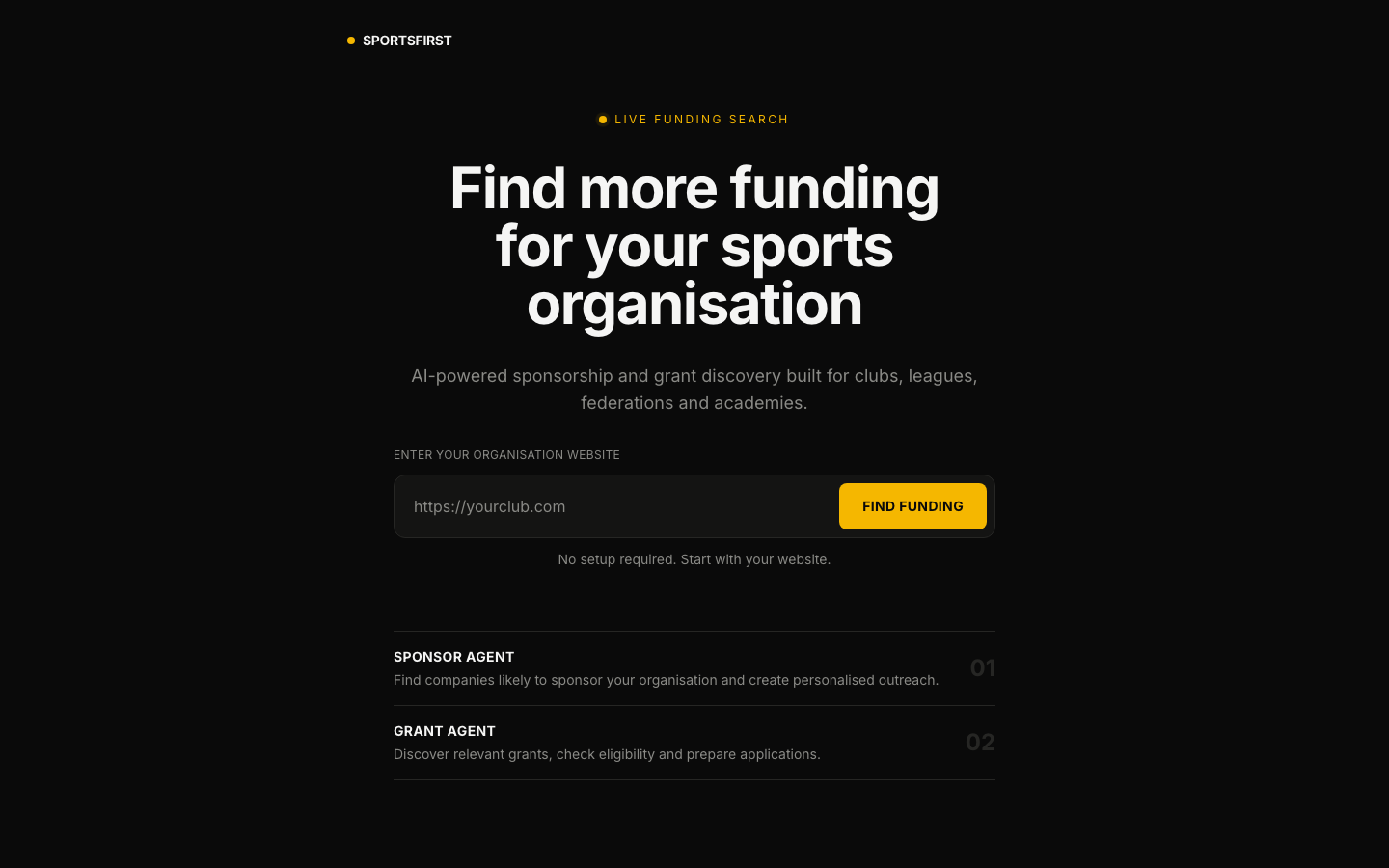
This proposed AI grant finder agent is built on a tracked history of over $450 million already awarded to US sports organisations, including how often each program funds, at what scale, and to what kind of organisation, so a club or league sees a shortlist ranked by realistic funding likelihood rather than a list ranked by keyword match.
The list that matters is shorter than the list that exists
Open grant databases are built to be exhaustive, which is exactly why they are hard to use. A program director searching for funding has no dedicated development staff and a limited number of evenings, and reading eligibility criteria for forty programs to find the two worth applying to is where most of that time disappears.
Ranking by tracked award history, not just topical fit, surfaces the funder that has quietly supported a dozen comparable organisations ahead of the well-known program that almost never awards to groups like this one.
Frequency is the signal a generic search throws away
A grant that funds one national recipient once every three years and a grant that funds twelve regional recipients every year can look identical on a category-filtered list. They are not remotely the same opportunity for a small club.
Surfacing program frequency and typical recipient profile alongside each match is what turns a technically-open grant into a realistically-winnable one, and it is exactly the kind of pattern that only shows up once award history has actually been tracked at scale.
A draft, not a submission
Once a shortlist exists, the agent can produce a first-pass application narrative from the organisation's own profile, so a program director starts from a draft rather than a blank page. Funder-specific requirements, budgets, supporting documents and the final read-through still need a person who knows the organisation; the agent's job is to remove the blank-page cost, not the accountability for what gets submitted.
What it does not do
It does not submit an application, make an eligibility determination, or guarantee an award. Funders decide who gets funded. The agent's contribution is spending an organisation's limited hours on the applications actually worth finishing.
Where this starts
A first release takes an organisation's profile, returns a ranked grant shortlist with a plain-language eligibility summary and estimated likelihood per match, and drafts a first-pass narrative for each. Full submission workflows, portfolio-wide deadline tracking and post-award compliance reporting are deliberately left for a later release.
Questions we get asked
What is an AI grant finder for sports organisations?
It is a tool that ranks open grants by how likely a specific club, league or federation is to actually win one, using tracked award history and program frequency, rather than returning every technically open program that matches a topic or location.
How is this different from a grant database like GrantWatch or Instrumentl?
Those list open opportunities and let an organisation filter by focus area and location. This ranks them by funding likelihood for that specific organisation, using a tracked history of over $450 million already awarded to US sports organisations, so a smaller recurring funder can outrank a prestigious program that almost never awards to groups like theirs.
Does it guarantee a grant award?
No. It surfaces which programs are statistically worth the time to apply to and drafts a starting narrative, but the funder makes the award decision and eligibility is ultimately theirs to determine, not the tool's.
What does "funding likelihood" actually use as evidence?
Tracked history of grants already awarded to US sports organisations, including how often a given program funds, at what scale, and to what type and size of organisation, weighed against the profile of the organisation searching.
Can it write the full grant application for us?
It drafts a first-pass narrative from the organisation's own information as a starting point, not a finished submission. Funder- specific requirements, budgets and supporting documentation still need a person who knows the organisation to finish and check it before it is submitted.
Is this your workflow?
Tell us one sports workflow that still runs on paper, spreadsheets, WhatsApp or an outdated system. We will map it and show you what a simpler product looks like.
Tell us about itMore in Sponsorship & commercial operations
- AI Sponsorship Finder Software for Local Sports Clubs and LeaguesAn AI agent that matches local sports clubs and leagues to sponsors likely to fund them, built on a base of 40,000+ tracked US leagues and 30,000+ sponsors by category, with drafted outreach for each match.
- Sponsorship Inventory Management SoftwareA governed ledger of sellable rights where holds are explicit and expire, exclusivity conflicts surface at the point of offer, and sell-through is visible rather than reconstructed.
- Sponsorship Portal Software for Sports OrganisationsA secure sports sponsorship portal that gives commercial partners one place to review activations, exchange assets, approve work and access delivery evidence and reports.
- Sports Sponsorship Contract Management SoftwareThe handful of contract dates that carry consequences, lifted out of the signed document into owned records with notice windows calculated backwards from the renewal date.
- Digital Game Sheet App for Sports LeaguesA match-day digital game sheet connecting today's fixture, the participating players, waiver status, live goal and card capture and the final official match report, without becoming a league management platform.
- Sports Calendar Marketing Platform for Teams & LeaguesA sports calendar marketing platform that turns fixtures and events into live, subscribable calendar feeds that stay correct when schedules change.
- Player Eligibility and Transfer Compliance Software for FootballA football player eligibility software concept that turns transfer, registration and approach rules into a cited briefing for human compliance review.