Sports Facility Booking Software and Venue Marketplace
By Arpan Desai, Founder, SportsFirst
Sports facility booking software that helps players discover and book courts, fields and sports venues while operators manage listings, bookings and earnings and platform admins control approvals, payouts, promotions and marketplace analytics.
Problem
Booking a sports venue still breaks across too many disconnected steps. Players and organisers search manually across social pages, messaging groups, spreadsheets, web forms and individual operator websites just to find an available court or field. Venue operators then manage availability in one place, customer messages in another, payments somewhere else, and payout reconciliation in yet another process. If the business runs a network or marketplace of venues, the complexity grows further: new venue onboarding, listing approvals, image and pricing reviews, operator support, promotions, commission rules, revenue reconciliation and performance reporting are all handled through fragmented admin work. The organisation may technically offer bookings, but it does not yet have a reliable sports facility booking platform.
Product idea
A sports facility booking software platform that connects players, clubs and organisers with available courts, fields and sports venues, while giving venue operators and platform admins a complete operating layer for supply, demand and monetisation. Users search by sport, location, date, capacity and venue type, then book and pay through a controlled flow. Venue operators list facilities, configure availability, pricing and amenities, receive bookings and track earnings. Platform admins approve new venues, manage users and operators, control commissions and payouts, run featured listing campaigns, and monitor marketplace analytics such as bookings, revenue, conversion and venue growth. The product combines marketplace discovery, booking operations, payout administration and first-party data in one coherent platform.
Where the AI agent does the work
The narrowest task worth automating first is the payout reconciliation the problem calls out directly — applying platform fees, matching booking revenue to the right operator and surfacing what is due, continuously, instead of as a separate process someone runs from spreadsheets after the fact. The same approach applies to venue onboarding: a submission arrives with imagery, pricing and amenities already checked against what the queue needs, so a reviewer approves, edits or rejects rather than chasing incomplete listings by email. Neither step decides anything the platform admin does not already decide today; both remove the manual assembly work that currently sits between a booking happening and the operator knowing what they are owed.
- Roles involved
- Platform operations director, Venue partnerships manager, Commercial manager, Finance operations lead, Venue operator, Facilities manager
- Relevant to
- Venue & stadium operator, Professional club, Collegiate athletics, Federation / governing body, Academy & youth
- Systems in play
- Facility booking spreadsheets, Shared calendars, Venue onboarding forms, Payment gateways, Payout workflows, CRM and support tools, Analytics dashboards, Messaging apps
A proposal worked through in full
A different problem, taken all the way to architecture, standards and a phased delivery plan — the level of detail any idea here can be developed to.
Sports Sponsorship Activation Platform for Interactive Live StreamingAlso relevant keywords: sports venue booking platform, court booking software, field booking platform, sports venue management software, athletic facility reservations, sports complex booking software.
A booking marketplace for sports venues is no longer just a calendar with available slots.
If the organisation wants to attract players, onboard quality venues, collect payments, reconcile operator payouts, promote selected inventory and understand marketplace performance, then it needs a real operating platform rather than a chain of forms, messages and spreadsheets.
This idea is the product-level layer above ordinary scheduling. It turns sports venue inventory into a searchable, bookable and commercially manageable network.
Why this category matters
Many sports organisations already understand they have spare capacity in their courts, fields, studios, turf cages, meeting rooms or training spaces. The problem is not the existence of the inventory. The problem is commercialising it consistently.
The typical failure pattern looks like this:
- players cannot easily discover what is available
- venue operators respond to booking requests manually
- approvals for new venues are inconsistent
- payments are captured, but payouts are reconciled manually
- promotions are one-off campaigns instead of an operating lever
- reporting is descriptive at best and fragmented at worst
The result is a platform that feels active from the outside but runs on manual operations behind the scenes.
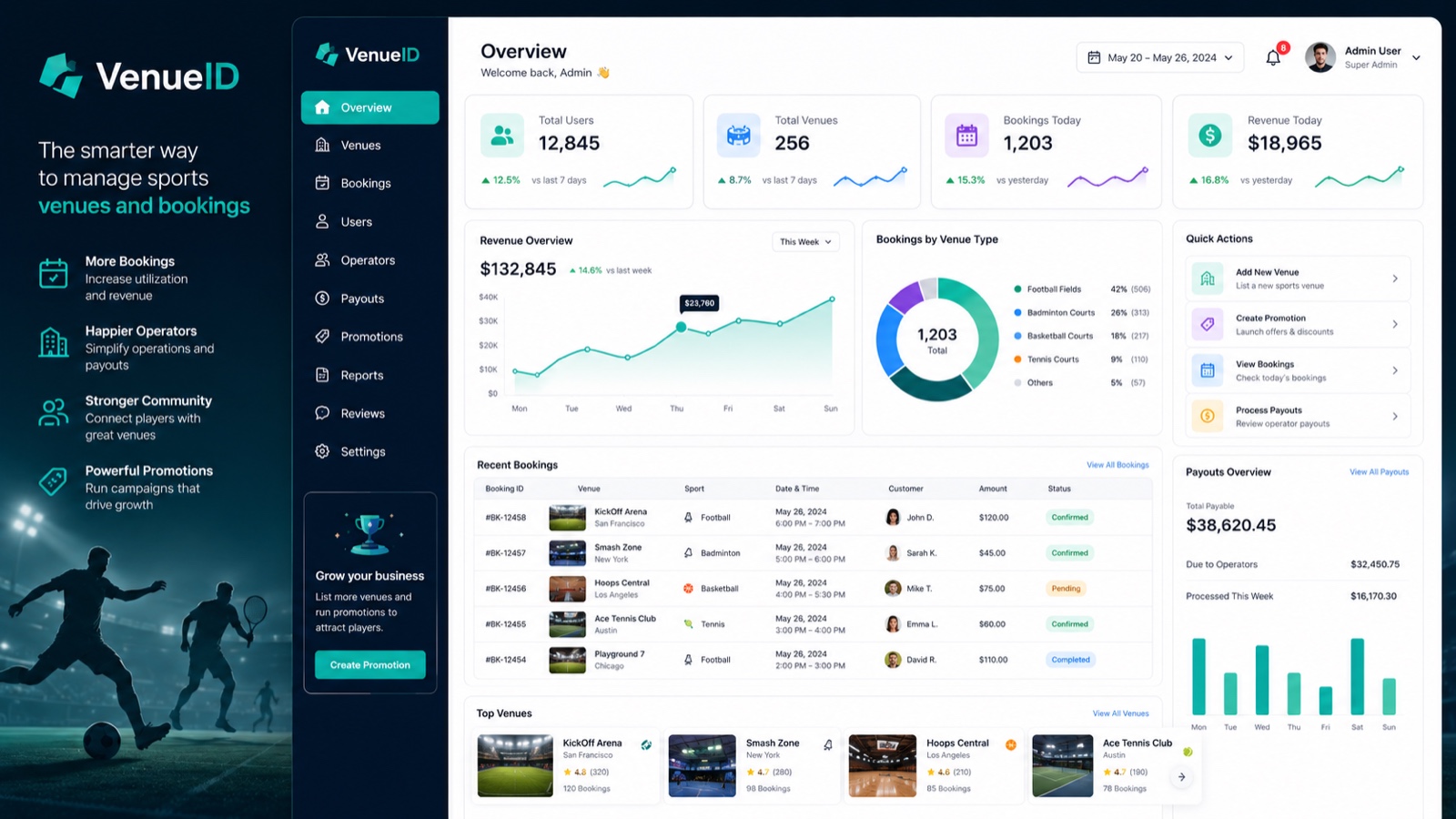
Concept design. The platform operator's view across bookings, revenue and supply growth. Venues, operators and figures shown are illustrative.
Product boundary
This idea should be positioned as sports facility booking software with a multi-venue marketplace and admin operating layer.
That means it covers three connected surfaces:
1) Booker experience
The player, parent, coach, team manager or organiser can:
- search venues by sport, city, area, date or facility type
- compare venue details, images, amenities and pricing
- check available slots
- book and pay
- review their booking history
- manage cancellations or rebooking where allowed
2) Venue operator experience
The operator can:
- submit a new venue for approval
- configure courts, fields or bookable spaces
- set amenities and operating information
- manage basic pricing and availability
- receive and track bookings
- see revenue and payout status
- participate in featured listing or promotion programs
3) Platform admin experience
The marketplace or network operator can:
- review and approve venues
- manage venue records
- manage users and operators
- monitor booking activity
- apply commission rules
- reconcile or mark payouts
- run advertisements, featured listings or campaigns
- track revenue, growth and conversion analytics
- control settings, templates and platform policies
This three-sided structure is what makes the idea distinct from a narrower internal scheduling product.
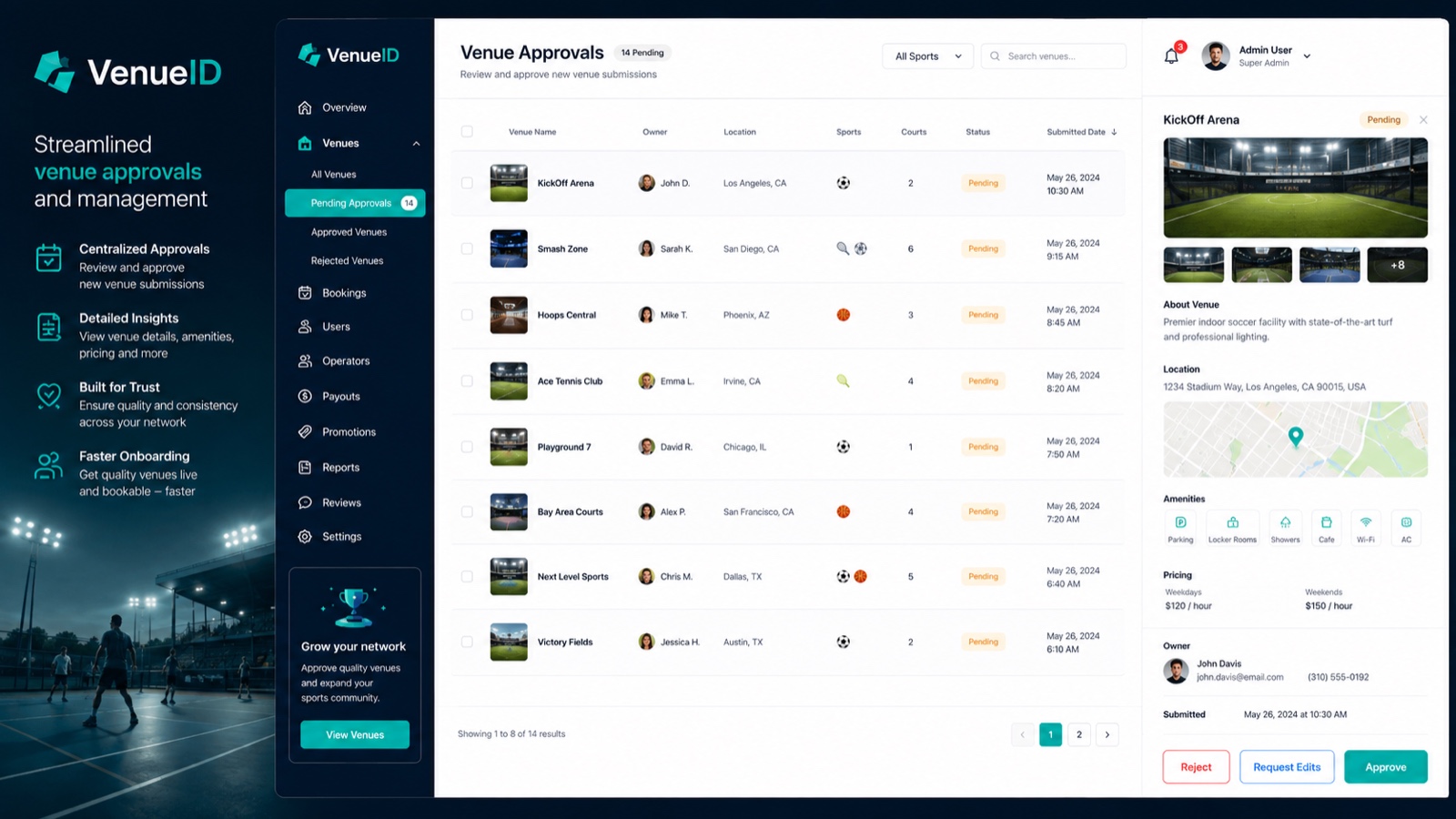
Concept design. Onboarding is a review queue rather than an inbox: each submission carries owner, location, sports, capacity, images, amenities and pricing, for approval, edit request or rejection.
Core workflows
Venue onboarding and approvals
A new supply-side workflow starts before the first booking ever happens. Venue operators submit listing data, imagery, amenities, sports, court counts, location details and pricing information. Admin reviewers then need a clear queue for what is pending, what needs edits, what is approved and what should be rejected.
This workflow matters because weak onboarding quality damages the marketplace long before it shows up in analytics. If poor imagery, unclear pricing or incomplete venue details go live, bookings drop and support queries rise.
Search, availability and booking
On the demand side, the platform needs more than a basic slot grid. The usable first experience is a filtered venue search paired with clear availability, supported sports, location and booking conditions. A booker should understand whether a site is appropriate before reaching the final payment step.
Payments, commissions and operator payouts
A marketplace cannot stop at payment collection. It has to decide what portion belongs to the platform, what portion belongs to the operator, when the payout becomes due and what evidence finance or operations teams need when reconciling the numbers.
That payout workflow is where many otherwise promising booking products begin to fail operationally. It is therefore part of the core product, not a back-office afterthought.
Promotions and featured inventory
Featured listings, discounts and spotlight campaigns are not optional extras in many venue networks. They are the mechanism by which the platform can create supply-side value and drive user demand. The system should therefore make promotions visible, administrable and measurable.
Analytics and first-party data
Once the business runs through the platform, the organisation should be able to answer practical questions quickly:
- which venues convert best
- which sports produce the most bookings
- which operators are active but underperforming
- how much revenue was booked this week
- what is currently due in payouts
- whether a featured listing actually moved demand
The first version does not need a data warehouse-grade analytics stack, but it must provide enough first-party visibility to steer operations.
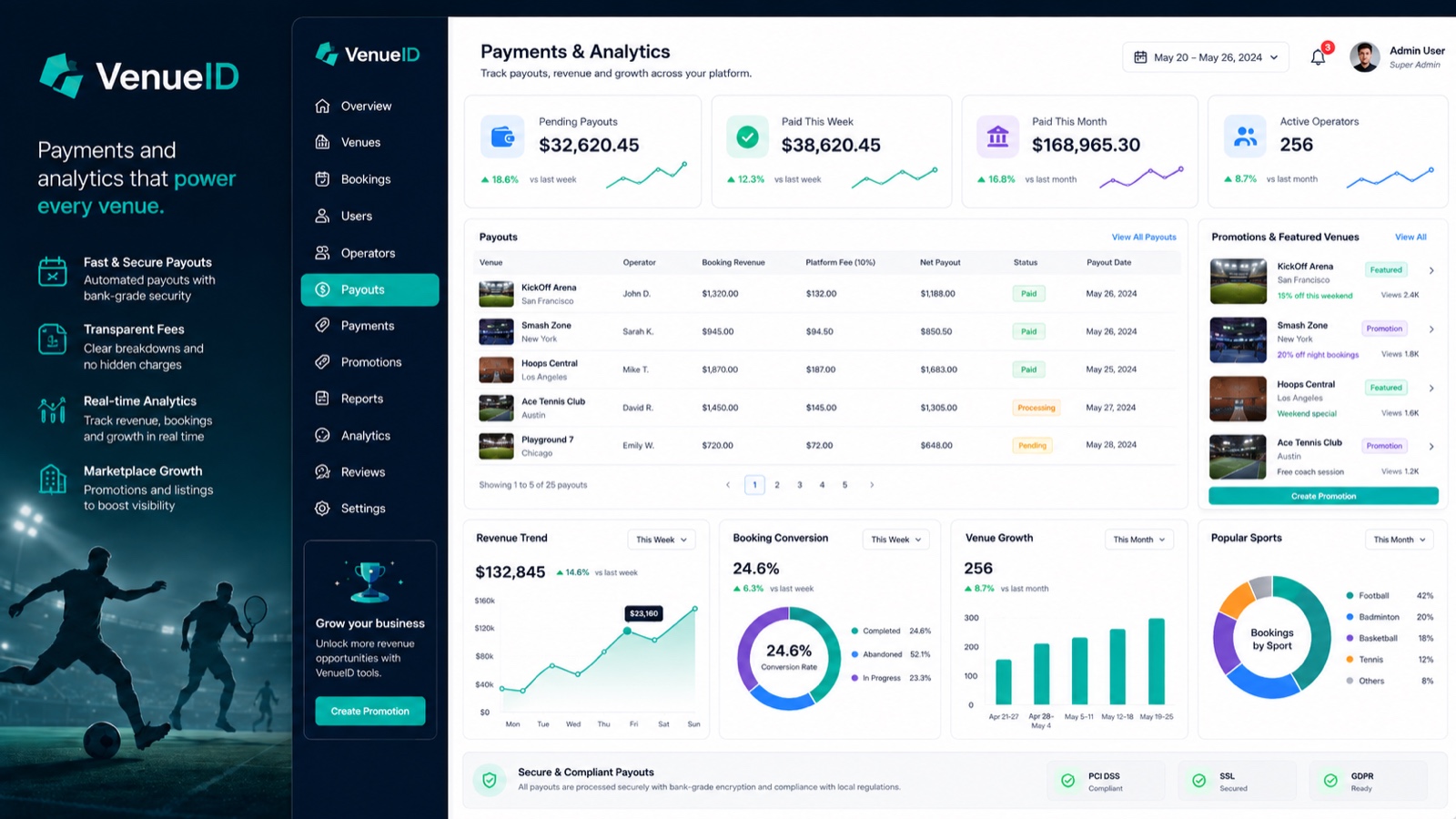
Concept design. Payments, commission and payout reconciliation alongside marketplace performance. All figures shown are illustrative.
What the first version should contain
A strong first phase should focus on the operating core:
- public venue discovery
- venue detail pages
- availability and slot booking
- payment capture
- venue submission and approval workflow
- venue management
- user and operator management
- commission configuration
- payout workflow
- featured listings or promotions
- top-level marketplace analytics
- settings for policies, admin roles and templates
That set is broad, but it is still coherent. Each module directly supports the commercial operation of the booking network.
Where the boundary sits
It should not claim to be all sports venue software at once.
Version one does not need to include:
- tournament and fixture management
- team roster or membership administration
- stadium maintenance workflows
- facility inspections
- matchday readiness control
- complex workforce scheduling
- advanced dynamic pricing logic
- full enterprise CRM automation
Keeping the scope disciplined is what allows the product to launch as a coherent booking and marketplace platform rather than a vague all-in-one promise.
Where this stops and facility scheduling starts
Scheduling software answers an internal question: who has the pitch on Tuesday, and does it clash. Its users all work for the same organisation, no money changes hands at the point of booking, and the hard part is conflict detection.
This answers a commercial one. Supply is owned by third parties who must be onboarded and approved, demand comes from people with no relationship to the organisation, money moves between them, and the hard parts are trust, payment and payout.
An organisation running its own facilities for its own teams wants the scheduling product. An organisation whose facilities are a revenue line, or which aggregates other people's venues, wants this one. A few want both, and they connect at availability.
Questions we get asked
How is this different from facility scheduling software?
Facility scheduling software usually helps one organisation coordinate its own spaces and avoid clashes. This product goes further by supporting marketplace-style discovery, customer booking, payments, operator onboarding, approvals, commissions, payouts and platform-wide analytics across many venues.
Can venue operators manage their own listings?
Yes. Operators can create or edit venue profiles, define sports and facility types, upload images, set amenities, manage basic pricing and configure available bookable spaces, while the platform admin retains approval control where required.
Does the platform support payouts to venue operators?
Yes. A core part of the product is reconciling booking revenue, applying platform fees, surfacing pending payouts, recording paid amounts and giving operations or finance teams a structured payout workflow instead of ad hoc spreadsheets.
Can the platform promote featured venues?
Yes. Featured listings, promotions and campaign placements are built in because commercial visibility is often part of the marketplace model. Admin teams can feature selected venues, run time-bound promotions and monitor their performance.
Is this only for private sports startups?
No. The same model also works for clubs, municipalities, university recreation programs, federations and venue networks that need a digital booking layer across multiple facilities.
What analytics should the first version include?
Start with venue growth, booking volume, revenue, active operators, booking conversion, top-performing venues, popular sports, payout status and promotion performance. That is enough to support operating decisions without overbuilding the first release.
Build this with SportsFirst
We work with teams, leagues, federations and venues to build custom sports software. Learn about our custom development services or read our sports app cost guide.
Is this your workflow?
Tell us one sports workflow that still runs on paper, spreadsheets, WhatsApp or an outdated system. We will map it and show you what a simpler product looks like.
Tell us about itMore in Venue, facility & ground operations
- Sports Facility Inspection Software for Stadiums & GroundsMobile facility inspection software for stadiums and grounds that replaces paper checklists with configurable inspections, offline capture, photo evidence, QR asset checks, issue escalation, readiness views and exportable audit records.
- Sports Facility Maintenance Software for Stadiums & VenuesFacility maintenance software for stadiums and venues that captures maintenance requests, routes work to named owners, tracks emergency contractor callouts, builds asset histories, surfaces recurring failures and repair spend, and keeps certificates and permits visible before they expire.
- Stadium Operations Software for Matchday ReadinessStadium operations software giving venue teams one matchday readiness board for critical systems and department sign-offs, countdown alerts before gates open, post-event readiness analytics and scenario planning for tight turnarounds.
- Facility Scheduling Software for Sports OrganisationsA sports facility scheduling system that gives teams and administrators one reliable view of field, court and training-space availability with conflict checking and self-service booking.
- Sports Recruitment Platform for Sports OrganisationsA sports-native hiring platform covering permanent, contract, freelance and casual matchday roles in one place, with a returning-worker register and an assistant layer that explains its matches rather than scoring candidates.
- Sports Team Travel Management Software for Clubs and LeaguesSports team travel management software that gives team managers a shared itinerary, RSVP and availability tracking, travel consent collection, payment management and parent notifications for away fixtures and tournaments — replacing group chats and spreadsheets.
- Sports Fan Loyalty Program Software for Teams & LeaguesSports fan loyalty software connecting attendance, engagement and commerce to points, tiers, milestones, rewards and accountable fulfilment.
- Sports Injury Management & Athlete Injury Reporting SoftwareSports injury management software that turns an athlete's injury or niggle report into a structured triage, acknowledged training modification and timestamped staff workflow.